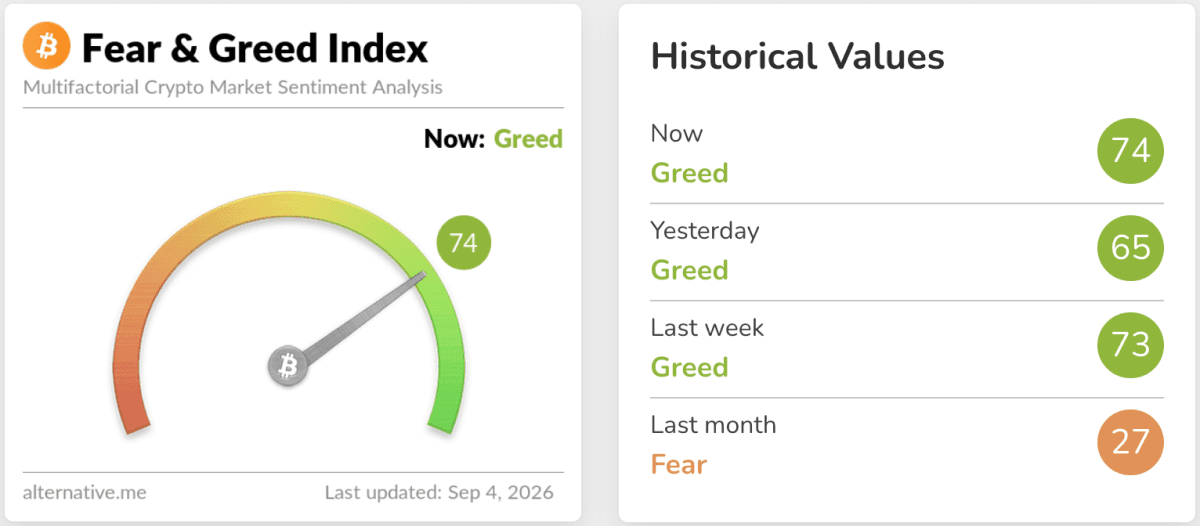
Bitcoin pushed above $81,000 on September 4 after Federal Reserve Governor Christopher Waller said he would favor holding rates steady if inflation continued to cool, easing rate-hike fears and lifting crypto alongside equities. Thursday also brought a $730.8 million net inflow into U.S. spot Bitcoin ETFs, led by BlackRock’s IBIT. The Fear & Greed Index reached 74, or “Greed,” up from 65 a day earlier and 27 a month ago. Stronger-than-expected U.S. payrolls later revived some rate-hike risk and Bitcoin eased back below $80,000. The week ended with risk appetite improved, but still sensitive to Federal Reserve expectations.
Wall Street banks plan joint dollar stablecoin
A coalition of 21 financial institutions, including Goldman Sachs, Bank of America, Citi and Deutsche Bank, announced plans on September 1 to create a company this year and issue a U.S. dollar-pegged stablecoin in the first half of 2027. The group also intends to expand into other G7 currencies, with a euro token a priority. It will compete with Qivalis, a separate 37-member consortium preparing a euro stablecoin. Bank-issued stablecoins still have limited adoption compared with incumbents such as Tether. The plan nevertheless marks another significant move by major banks toward blockchain-based money and settlement.
Coinbase seeks approval for equity perps
Coinbase filed registration documents with the U.S. Securities and Exchange Commission on September 3 seeking approval to offer equity perpetual contracts. Perpetuals track an underlying asset without an expiry date, allowing positions to stay open without rolling into a new contract. Chief Policy Officer Faryar Shirzad said the product would require Commodity Futures Trading Commission approval next and described it as a potential regulated pathway for U.S. investors. Coinbase already received CFTC approval earlier this year to offer perpetual crypto futures. If approved, equity perps would broaden the exchange beyond digital assets and test how U.S. regulators handle crypto-style market structure.
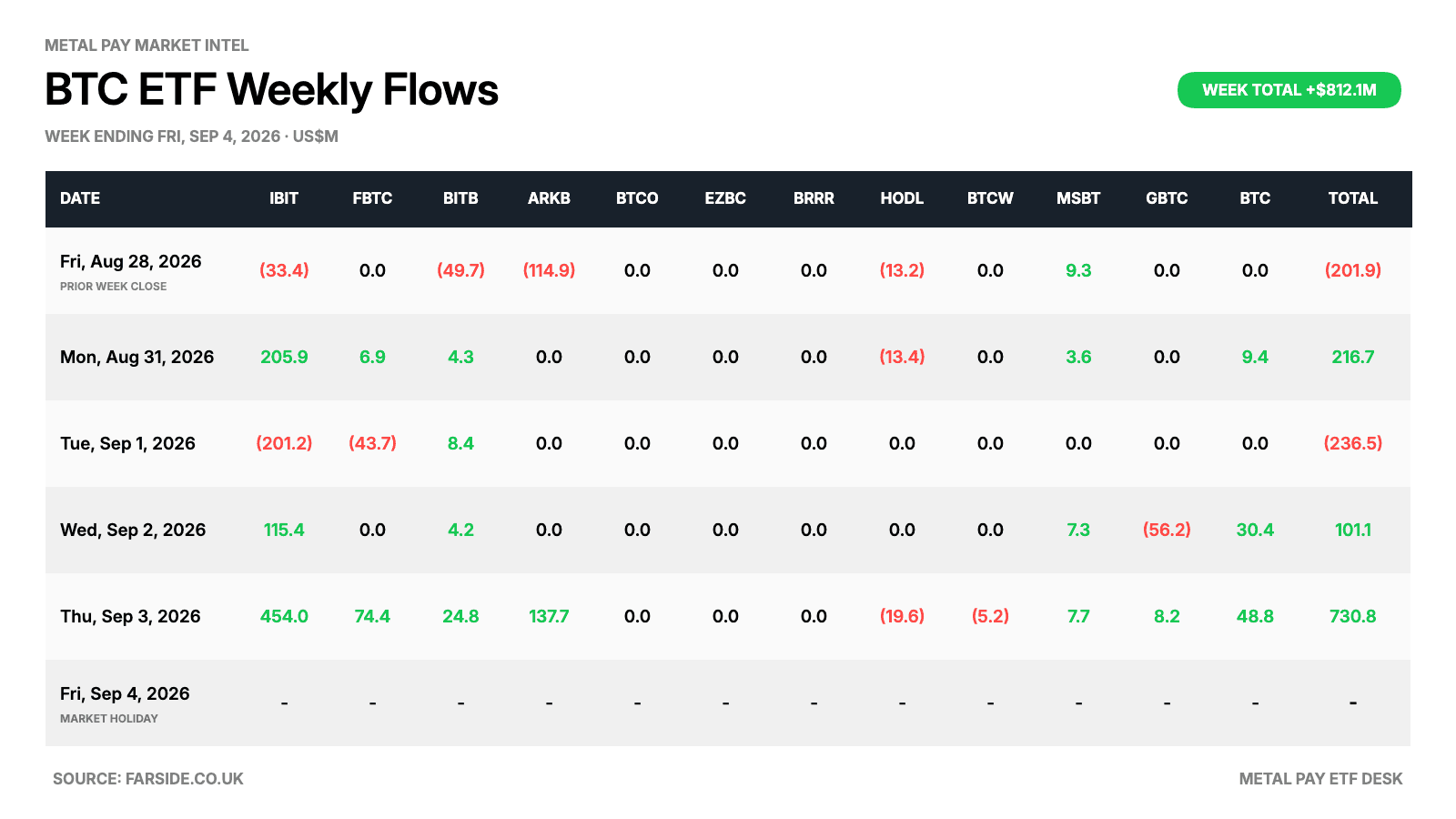
Monday opened with $216.7 million in net inflows, led by BlackRock’s IBIT at $205.9 million, while Fidelity’s FBTC added $6.9 million. Tuesday reversed to $236.5 million in net outflows as IBIT shed $201.2 million and FBTC lost $43.7 million, partly offset by $8.4 million into Bitwise’s BITB. Wednesday returned to $101.1 million in net inflows, led by $115.4 million into IBIT despite $56.2 million leaving GBTC, before Thursday surged to a week-high $730.8 million as IBIT added $454.0 million, ARKB $137.7 million and FBTC $74.4 million. Overall, the week finished with $812.1 million in net inflows, with BlackRock driving most of the positive momentum.
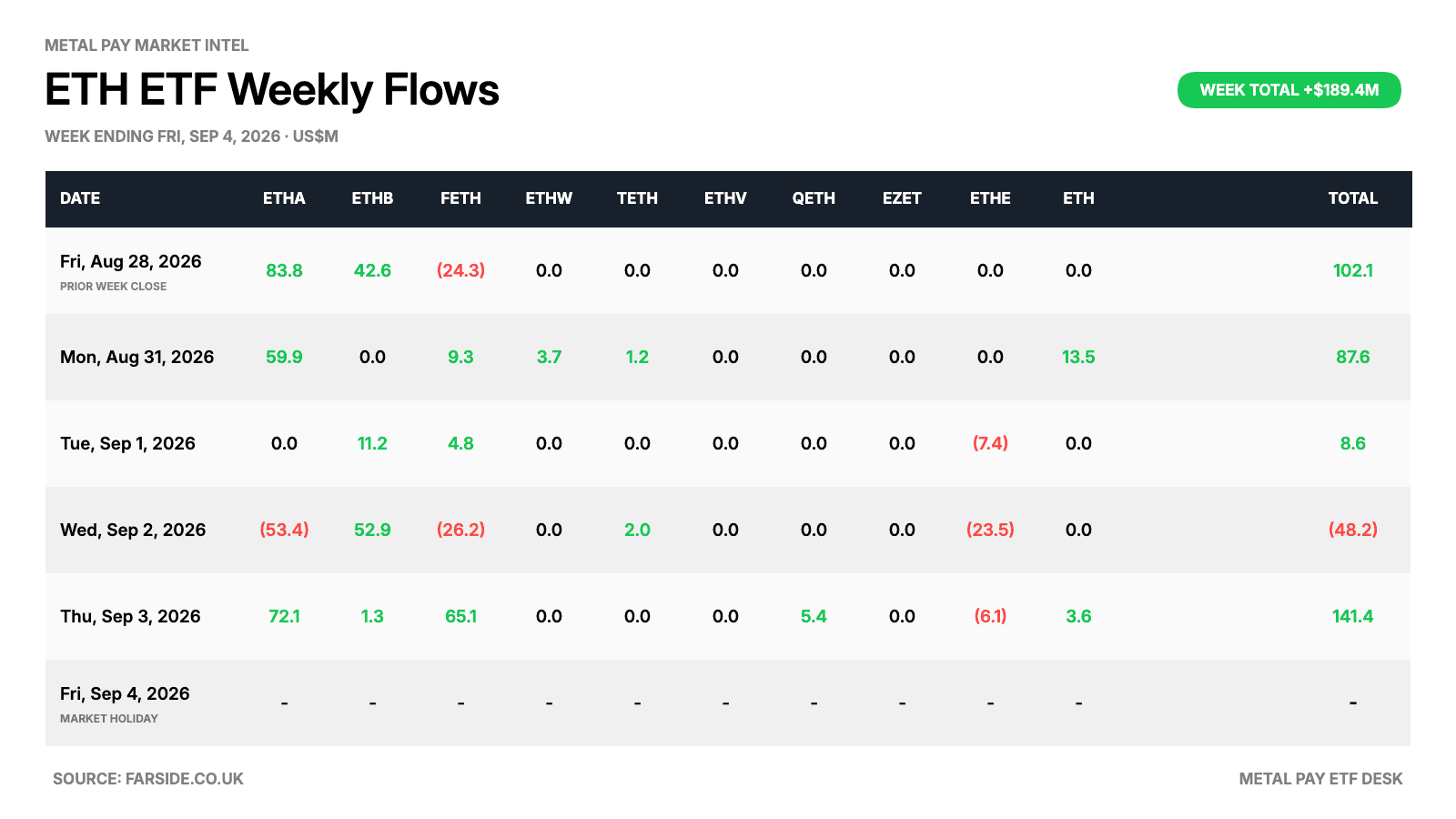
Monday opened with $87.6 million in net inflows, led by BlackRock’s ETHA at $59.9 million, while Grayscale’s ETH added $13.5 million. Tuesday remained positive at $8.6 million as ETHB brought in $11.2 million and FETH added $4.8 million, offset by $7.4 million leaving ETHE. Wednesday was the weakest session at $48.2 million in net outflows, with ETHA losing $53.4 million, FETH $26.2 million and ETHE $23.5 million despite $52.9 million flowing into ETHB, before Thursday rebounded to $141.4 million led by ETHA at $72.1 million and FETH at $65.1 million. Overall, Ethereum ETFs finished the week with $189.4 million in net inflows.
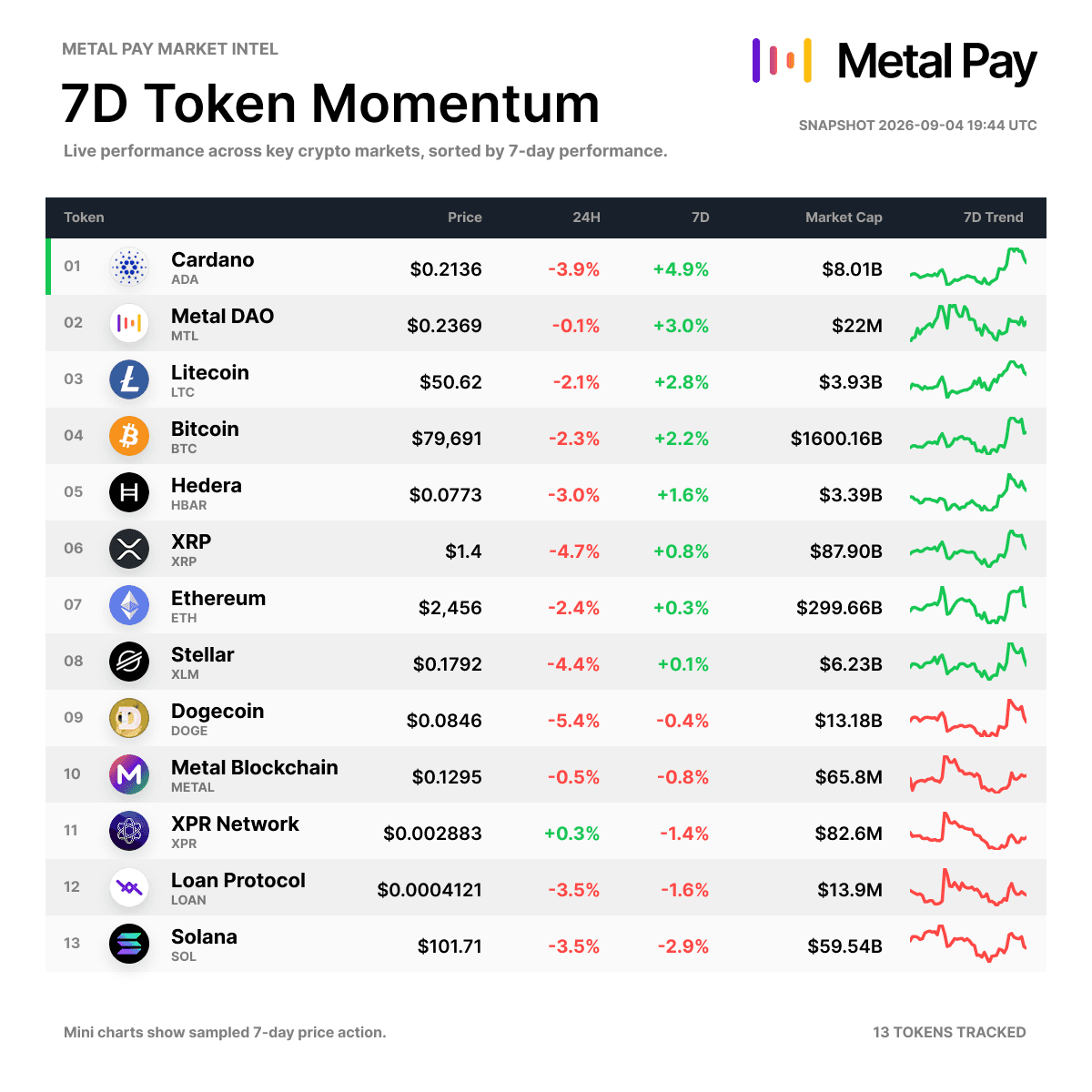
Cardano led the Metal Pay list with a 4.9% seven-day gain, followed by Metal DAO at 3.0%, Litecoin at 2.8% and Bitcoin at 2.2%. Hedera, XRP, Ethereum and Stellar also remained positive for the week, even as most of the tracked assets were lower over the latest 24-hour period. The result shows that the late-week market rebound was enough to keep several major assets in positive territory despite a volatile start to September.