Crypto markets ended July cautiously, with Bitcoin falling toward $63,000 and Ether slipping below $1,900 on July 31. The Crypto Fear & Greed Index stood at 25, returning to “Extreme Fear” from 28 yesterday and last week, although sentiment remained stronger than last month’s reading of 11. The Federal Reserve kept interest rates at 3.5%–3.75% on July 29, but its divided 9–3 vote and hawkish tone reduced expectations for near-term cuts. Bitcoin initially held near $64,000 before weakening as investors continued to favor equities over crypto. The combined signals point to fragile confidence despite July’s broader market recovery.
BNY Moves Fund Records Onto Blockchain
BNY launched digital transfer-agency capabilities this week, bringing blockchain infrastructure into a fund-servicing business covering approximately $8.6 trillion in assets and 7.6 million investor accounts. The system is designed to support tokenized funds across multiple jurisdictions and blockchains while operating alongside BNY’s traditional infrastructure. Baillie Gifford is using the service for what the companies describe as the first fully native, regulated tokenized fund in the United Kingdom, with BlackRock and BNY’s Dreyfus unit expected to follow. The rollout shows blockchain moving deeper into the record-keeping systems used by major financial institutions rather than remaining limited to cryptocurrency trading.
Coinbase Posts Third Straight Quarterly Loss
Coinbase reported its third consecutive quarterly loss on July 30 as weaker crypto prices and slower trading activity continued to pressure the exchange. Transaction revenue fell 21% from a year earlier to $599 million, while the company recorded a net loss of $359.5 million. Subscription and services revenue declined 12.2% to $555.1 million, although Coinbase continued expanding into stablecoins, prediction markets and regulated derivatives. The company also reached a record 10.3% share of crypto trading and said 88% of net revenue now comes from activities other than Bitcoin spot trading, showing how it is trying to become less dependent on market cycles.
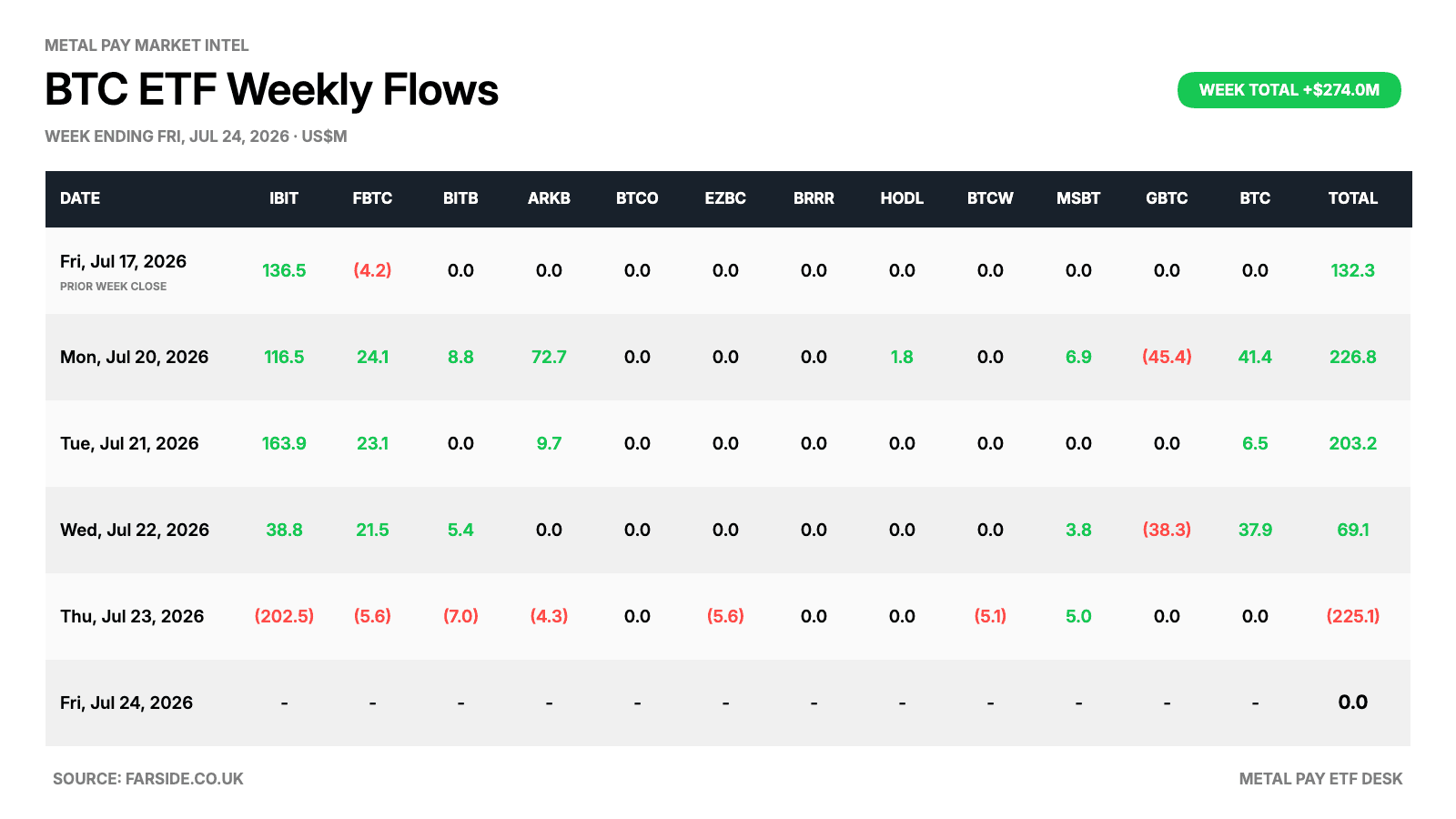
Bitcoin ETFs opened Monday with $11.6 million in net outflows, led by $8.8 million from BlackRock’s IBIT and $2.8 million from Fidelity’s FBTC. Tuesday’s outflows widened to $49.7 million as IBIT lost $54.8 million, partly offset by a $5.1 million inflow into Grayscale’s BTC. Wednesday reversed to a $32.1 million inflow before Thursday delivered the strongest result at $233.1 million, led by $183.4 million into IBIT, $20.7 million into Bitwise’s BITB and $15.5 million into FBTC. Overall, the funds recorded $203.9 million in net inflows from Monday through Thursday, with the late-week rebound outweighing the cautious start."
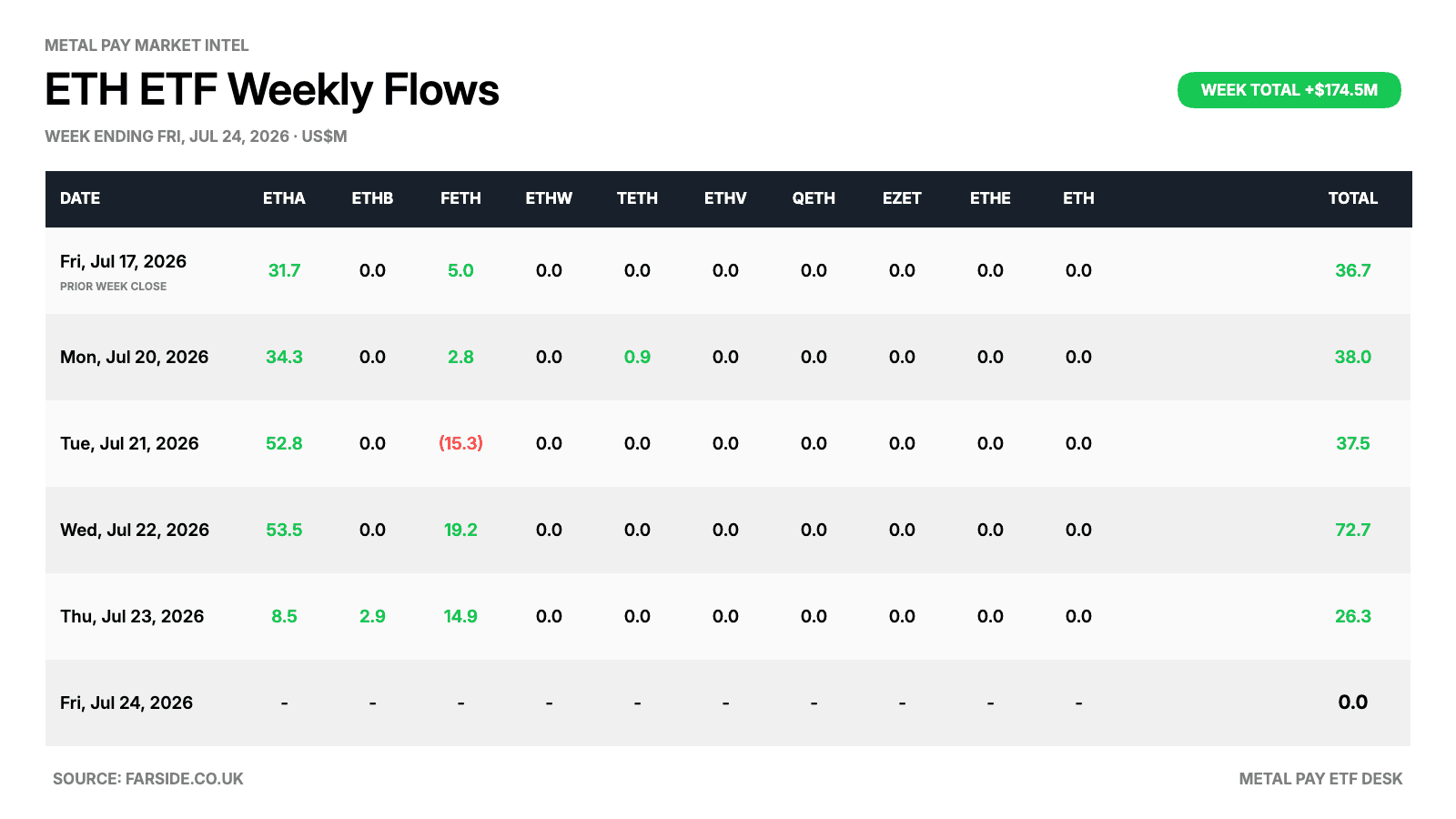
Ethereum ETFs began Monday with $11.7 million in net inflows, entirely led by BlackRock’s ETHA. Tuesday added another $9.4 million, with $5.9 million entering BlackRock’s ETHB and $3.5 million entering ETHA. Wednesday was the weakest day at $32.9 million in net outflows, driven by $16.1 million from Fidelity’s FETH, $9.7 million from Grayscale’s ETHE and $8.1 million from Grayscale’s ETH, before Thursday recovered with a $12.8 million inflow led by ETHA. Overall, the funds finished Monday through Thursday almost flat at approximately $1 million in net inflows, showing mixed institutional demand.
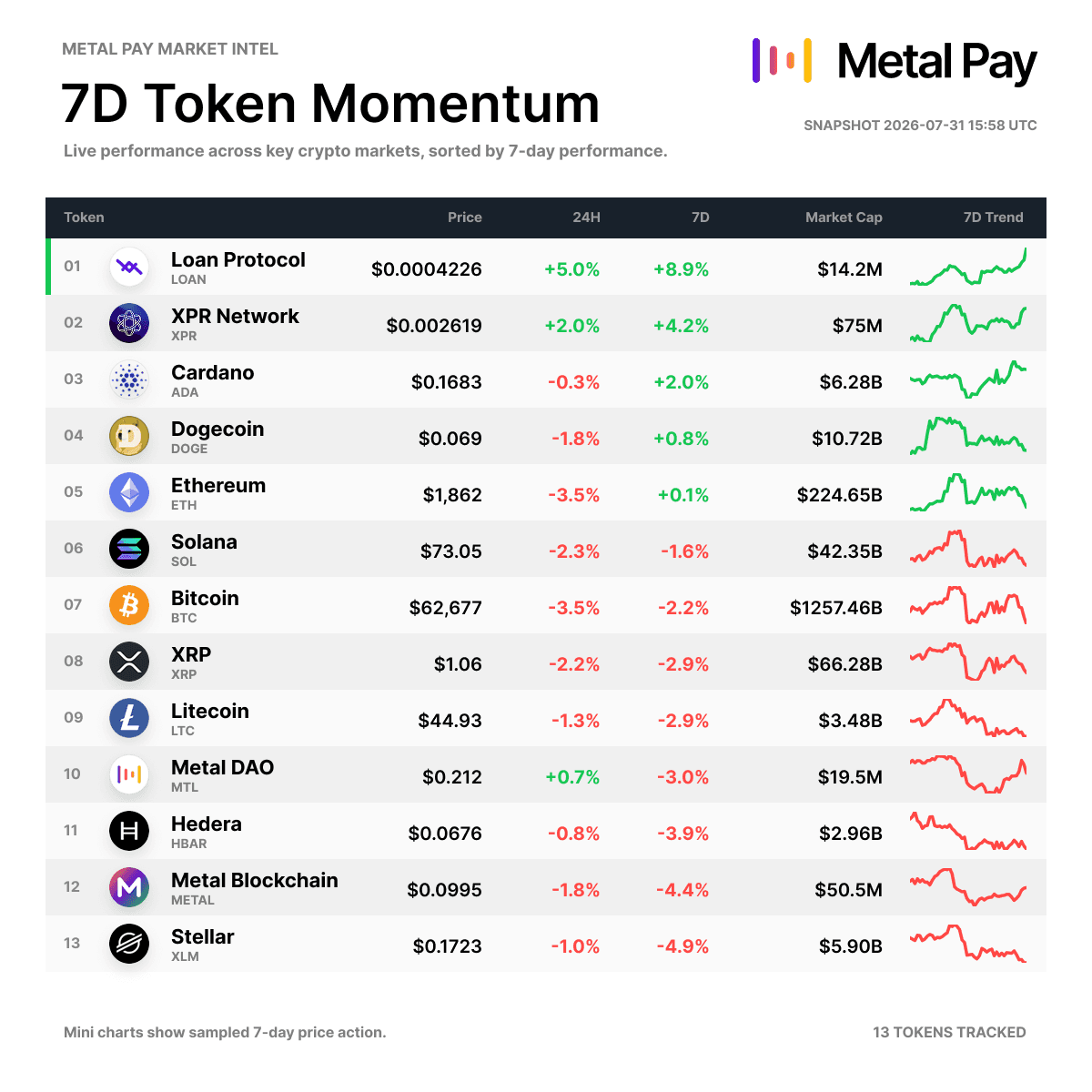
Loan Protocol led the tracked Metal Pay market with an 8.9% weekly gain, followed by XPR Network at 4.2%. Cardano gained 2.0%, while Dogecoin and Ethereum remained slightly positive despite Bitcoin falling 2.2% and broader sentiment returning to Extreme Fear. The performance showed selective strength in smaller ecosystem tokens even as most large-cap assets struggled to maintain their midweek gains.