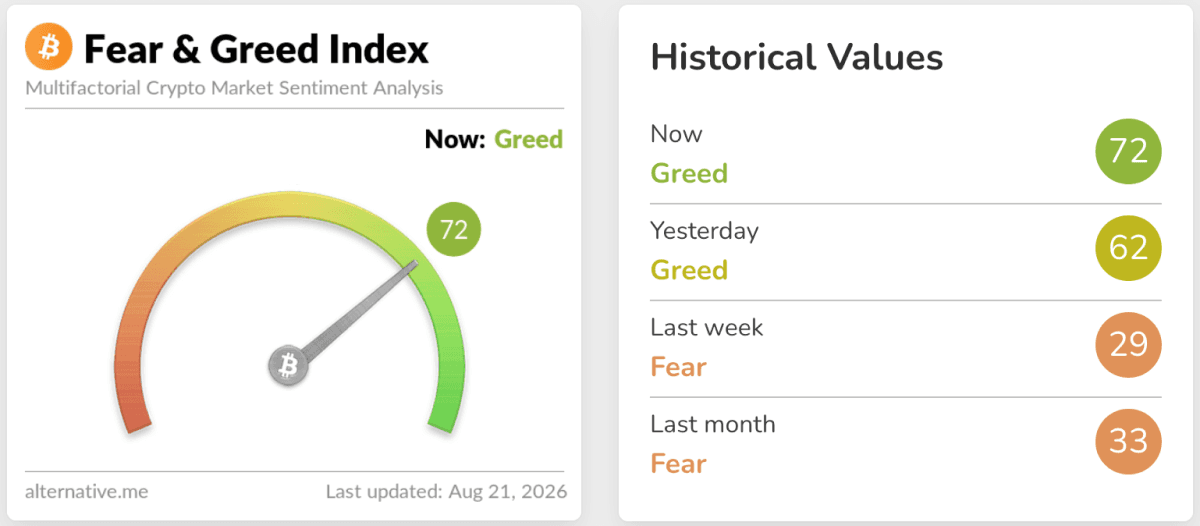
Bitcoin staged its strongest weekly advance in roughly two and a half years, climbing toward $80,000 as the U.S. Treasury expanded long-dated bond buybacks and spot ETF demand returned. The rebound spread across major tokens, with Ethereum and XRP also posting sharp gains as liquidity expectations improved. The attached Crypto Fear & Greed Index jumped to 72, firmly in “Greed.” That compares with 62 yesterday, 29 last week and 33 last month, showing how quickly sentiment reversed from fear. The move is constructive, but high bond yields and geopolitical risk remain important market headwinds.
SEC Proposes New Crypto Offering Rules
The SEC proposed “Regulation Crypto Assets” on August 18, opening a formal rulemaking process for token-based fundraising. The proposal would create a startup exemption for offerings of up to $5 million over four years and a second exemption allowing up to $75 million during a 12-month period, subject to disclosures and reporting. It also proposes a safe harbor that could let a crypto asset move outside securities-law treatment once promised managerial efforts have ended. Comments are open for 60 days. A day later, President Trump urged Congress to keep moving the separate Clarity Act.
Treasury Advances GENIUS Stablecoin Rules
The U.S. Treasury on August 17 proposed part of the GENIUS Act stablecoin framework, focusing on when payment stablecoins are considered issued, offered or sold in the United States. The proposal would help determine which issuers and distributors fall under U.S. licensing rules as the law moves toward implementation. Under the GENIUS Act, entities generally cannot issue payment stablecoins in the U.S. without a federal or state license once the regime takes effect. Treasury opened a 60-day public comment period. For users, the practical issue is which dollar stablecoins can legally reach U.S. customers and through which regulated issuers.
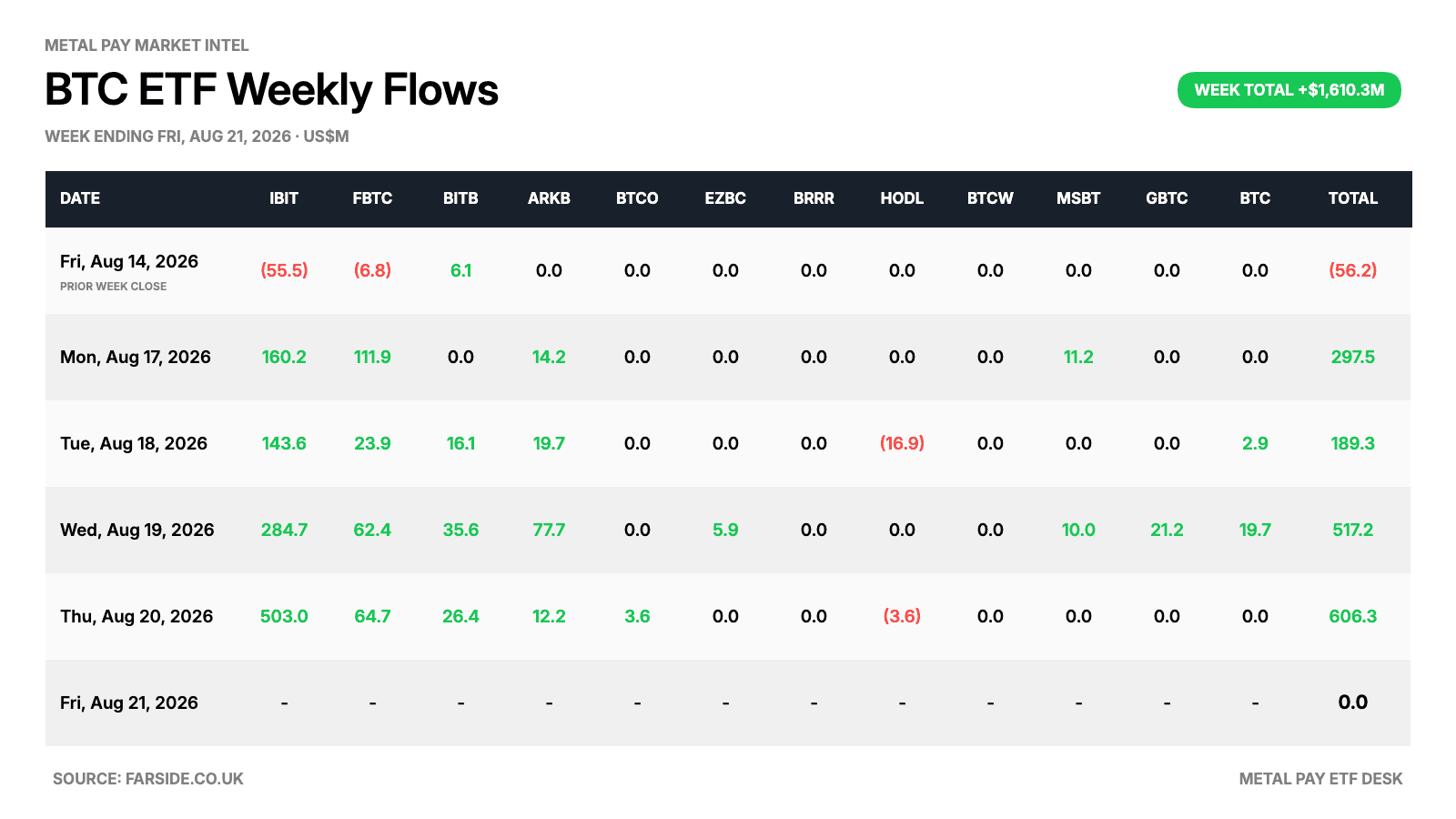
Bitcoin ETFs opened the week with $297.5 million in net inflows on Monday, led by BlackRock’s IBIT at $160.2 million and Fidelity’s FBTC at $111.9 million. Tuesday stayed positive at $189.3 million, with IBIT adding $143.6 million and FBTC $23.9 million, partly offset by a $16.9 million outflow from VanEck’s HODL. Wednesday accelerated to $517.2 million, led by IBIT with $284.7 million, ARKB with $77.7 million and FBTC with $62.4 million. Thursday was the strongest session at $606.3 million, driven by $503.0 million into IBIT and $64.7 million into FBTC. Overall, spot Bitcoin ETFs took in $1.61 billion for the week, marking a sharp return of institutional demand.
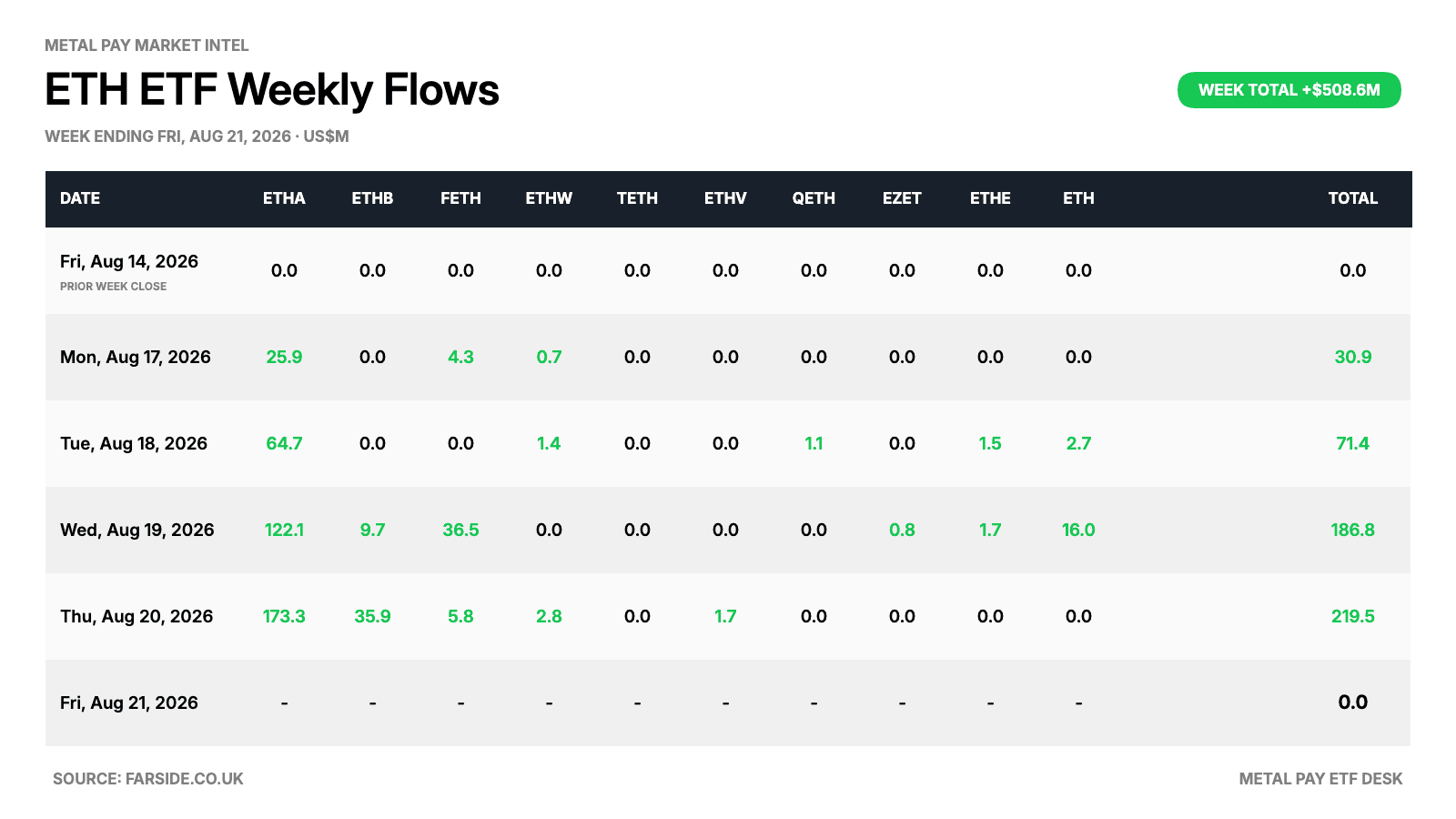
Ethereum ETFs started the week with $30.9 million in net inflows on Monday, led by BlackRock’s ETHA at $25.9 million and Fidelity’s FETH at $4.3 million. Tuesday strengthened to $71.4 million, with ETHA contributing $64.7 million and smaller inflows spread across several funds. Wednesday climbed to $186.8 million, led by ETHA at $122.1 million, FETH at $36.5 million and Grayscale’s ETH at $16.0 million. Thursday was the strongest session at $219.5 million, driven by $173.3 million into ETHA and $35.9 million into BlackRock’s staked ETHB fund. Overall, spot Ethereum ETFs attracted $508.6 million for the week, with BlackRock products accounting for most of the inflows.
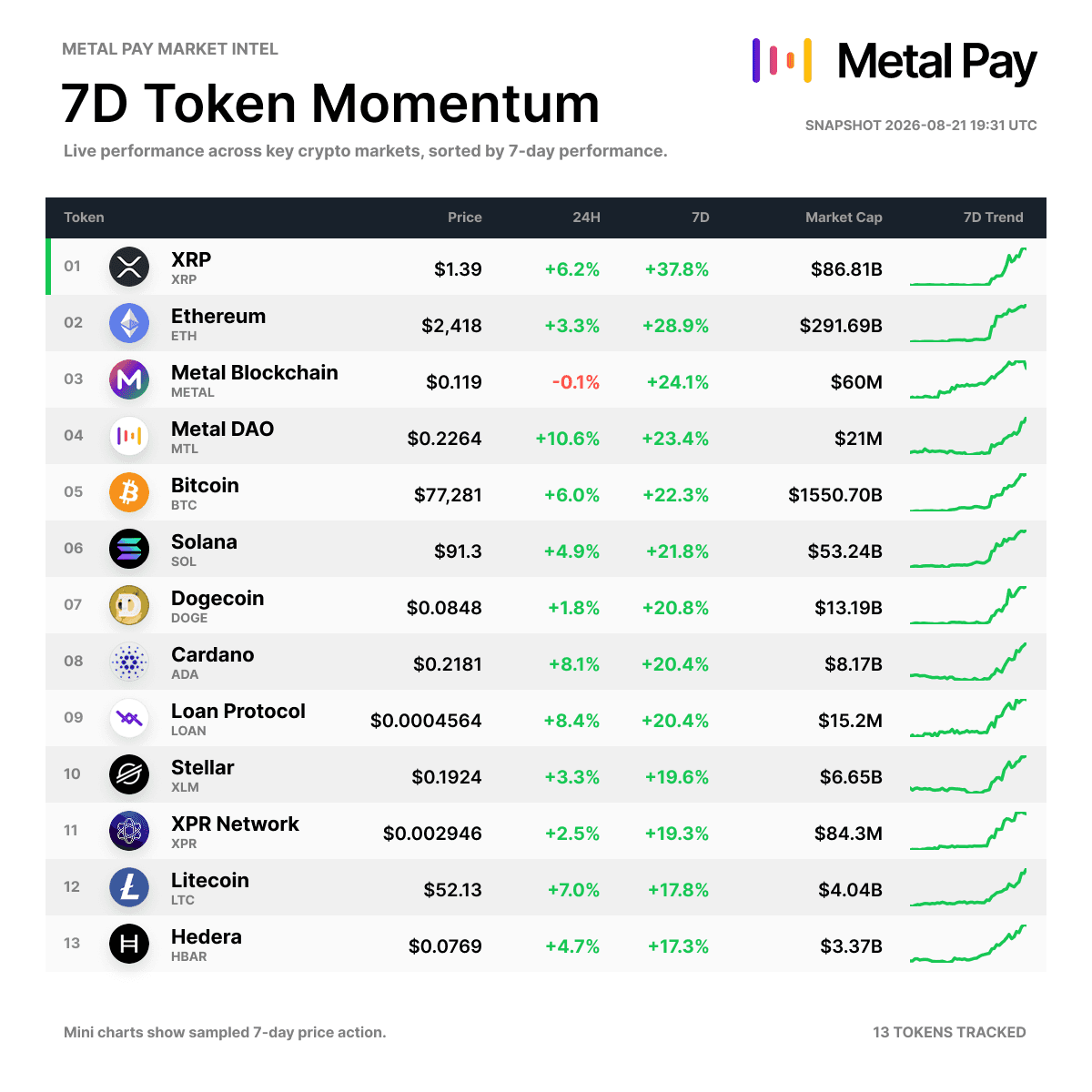
XRP was the strongest performer in the Metal Pay basket, up 37.8% over seven days, with Ethereum next at 28.9%. Metal Blockchain and Metal DAO gained 24.1% and 23.4%, while Bitcoin, Solana, Dogecoin, Cardano and Loan Protocol all rose more than 20%. The move was part of a broad risk-on rebound tied to improved liquidity expectations, renewed ETF inflows and friendlier U.S. crypto policy signals. XRP also led trading activity on South Korea’s largest exchanges as local crypto volumes surged. Even the weakest name in the group, Hedera, still gained 17.3%.