
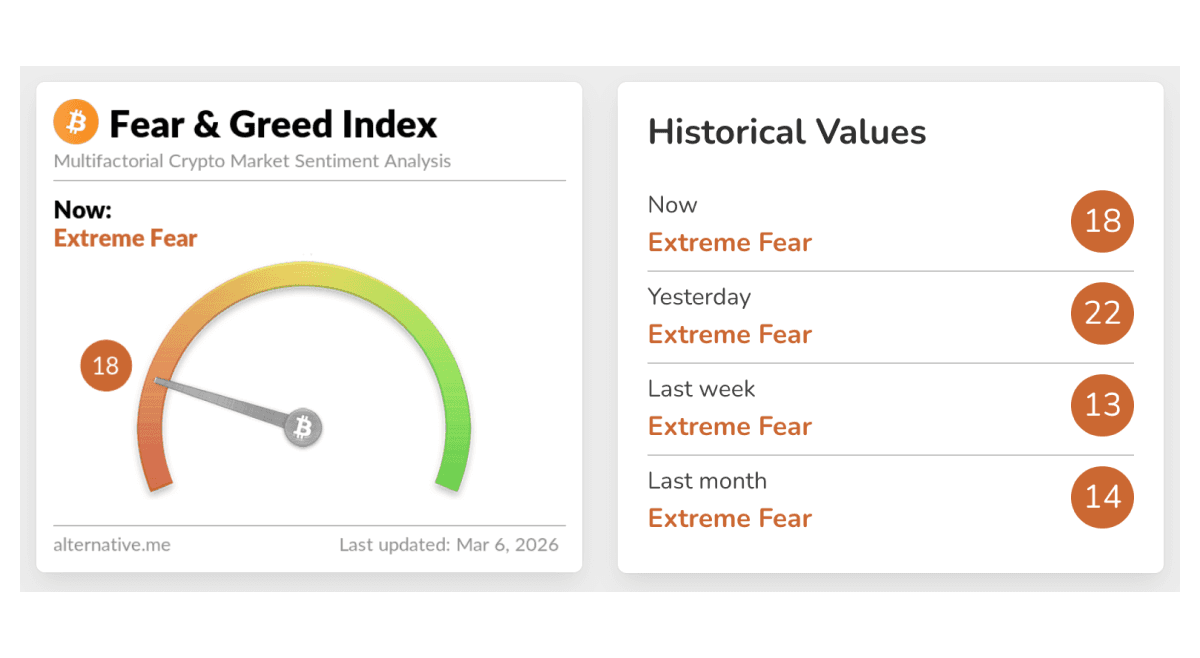
Crypto markets found some footing this week as risk appetite improved midweek, helped by a pause in oil’s surge and hopes that geopolitical tensions might not escalate further. On March 4 bitcoin rose 7.64% to about $73,245 while ether gained 9.23% to roughly $2,150, giving the market a relief bounce after a rough stretch. Even so, sentiment remains cautious rather than euphoric. The Crypto Fear & Greed Index was still sitting in Extreme Fear at 18 on March 6, up from 13 a week earlier but still well below neutral, suggesting traders are buying the bounce carefully rather than chasing aggressively.
Crypto Market Structure Talks Hit a Wall
One of the biggest policy stories this week was the latest setback for the U.S. Clarity Act, which is supposed to bring clearer rules to crypto firms and stablecoin-related products. Talks stalled again after banks rejected a White House-backed compromise over whether crypto companies should be allowed to offer rewards tied to stablecoins and similar products. Banks argue those features could pull deposits out of the traditional banking system, while crypto firms say restricting them would be anti-competitive and slow adoption. For payment platforms and regulated crypto businesses, the delay matters because it keeps key questions around product design, yield features, and compliance in limbo.
US Regulators Clear a Path for Tokenized Securities
U.S. regulators gave banks a useful signal this week by saying tokenized securities should not face extra capital charges simply because they are issued or transacted on blockchain rails. The Federal Reserve, FDIC, and OCC said their capital framework is technology neutral, meaning a tokenized security should generally be treated the same as a traditional one. That is a meaningful development for banks exploring blockchain-based settlement, treasury products, and tokenized investment rails. For the broader digital asset industry, it reinforces the idea that tokenization is moving closer to mainstream financial infrastructure rather than being treated as a special high-risk category.
Bitcoin ETF Flows
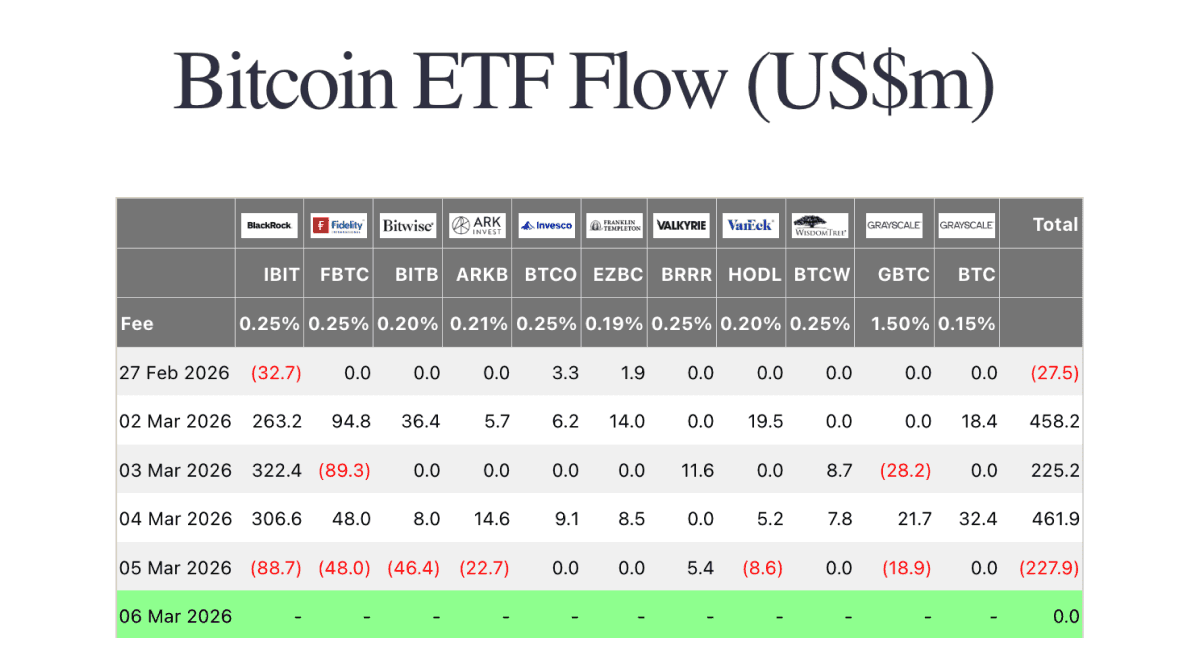
On Monday, U.S. spot Bitcoin ETFs posted a strong $458.2 million in net inflows, led by BlackRock’s IBIT at $263.2 million and Fidelity’s FBTC at $94.8 million. Tuesday stayed positive at $225.2 million, with IBIT bringing in $322.4 million while outflows from FBTC and GBTC partially offset the day’s total. Wednesday was the strongest session of the week at $461.9 million, again driven by IBIT with $306.6 million, alongside contributions from FBTC, BTC and GBTC. The previous Friday had been softer, with $27.5 million in net outflows as IBIT losses outweighed small inflows into BTCO and EZBC. Overall, Bitcoin ETF flows showed real demand earlier in the week before reversing sharply on Thursday with $227.9 million in net outflows led by IBIT, FBTC and BITB.
Ethereum ETF Flows
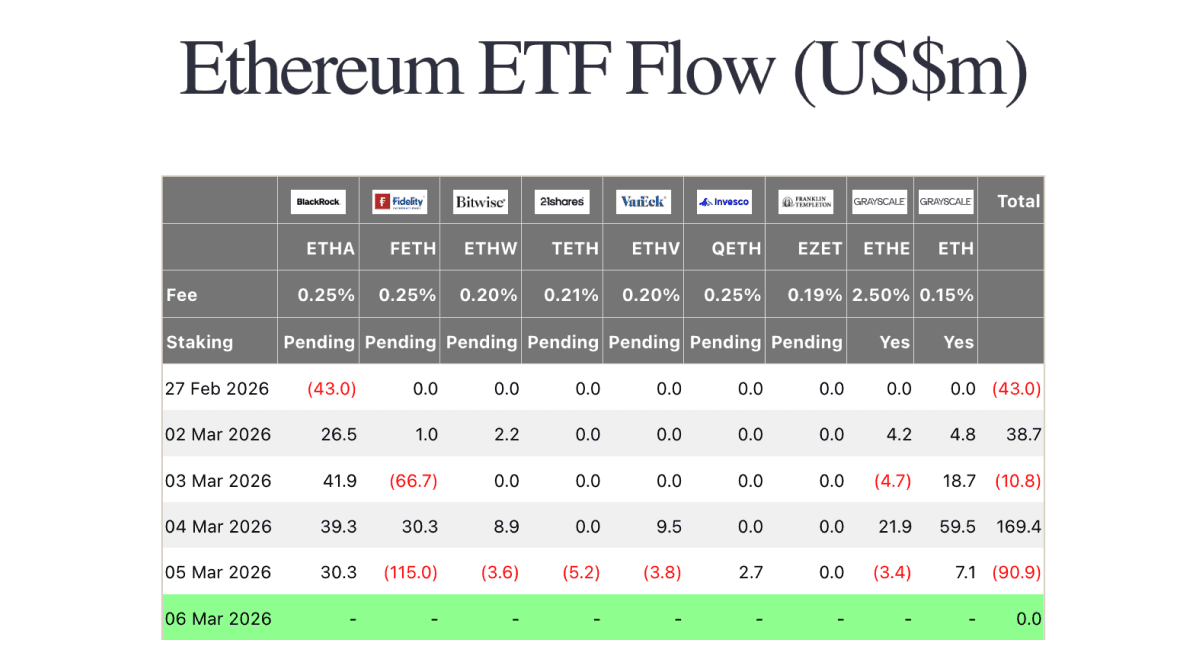
On Monday, U.S. spot Ethereum ETFs recorded $38.7 million in net inflows, led by BlackRock’s ETHA at $26.5 million with smaller support from Grayscale’s ETH and ETHE. Tuesday flipped to a modest $10.8 million in net outflows, as a $66.7 million withdrawal from Fidelity’s FETH outweighed inflows into ETHA and ETH. Wednesday was the strongest day of the week by far at $169.4 million, powered by Grayscale’s ETH at $59.5 million, ETHA at $39.3 million and FETH at $30.3 million. The previous Friday had seen $43.0 million in net outflows, entirely from ETHA. Overall, Ethereum ETF demand was more uneven than bitcoin this week, with a strong midweek surge giving way to Thursday outflows of $90.9 million led by FETH.
Top Movers (Coins Available on Metal Pay - 7 Day Chart)
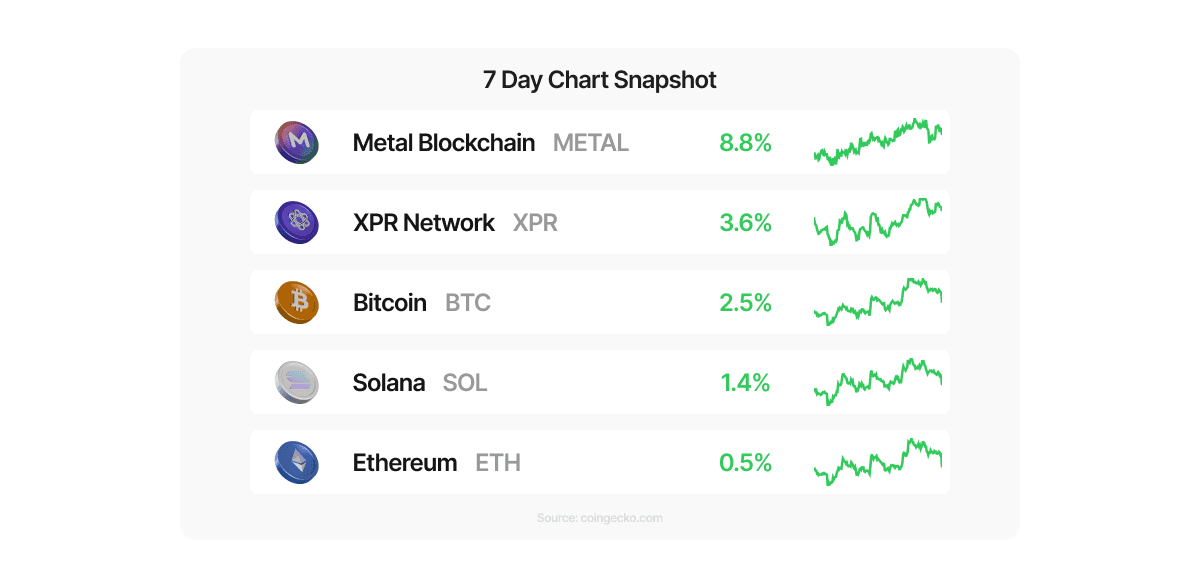
Metal Blockchain led this week’s movers with an 8.8% gain, clearly outperforming the rest of the list as ecosystem names held up better than many larger-cap assets. XPR Network followed at 3.6%, while Bitcoin, Solana and Ethereum posted smaller gains of 2.5%, 1.4% and 0.5% respectively. The pattern suggests traders rotated back into selective beta after the broader market stabilized midweek, with infrastructure-linked names seeing the strongest response. In short, this was less a full risk-on breakout and more a measured rebound, with METAL showing the most relative strength on the week.