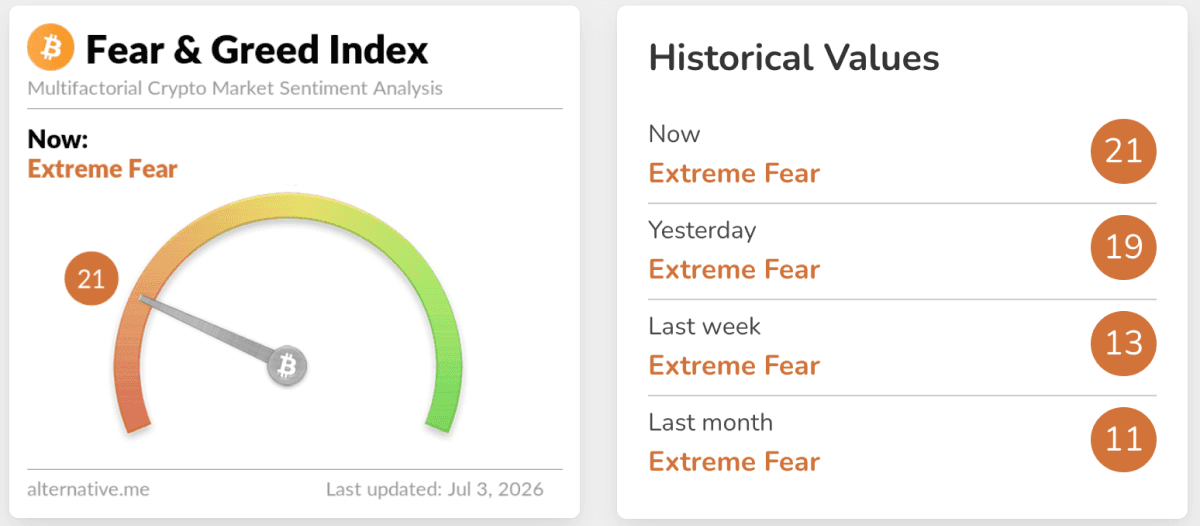
Crypto markets ended the week with a modest relief move, but sentiment remained deeply defensive. The Fear & Greed Index stood at 21 on July 3, up from 19 yesterday, 13 last week, and 11 last month, keeping the market in “Extreme Fear” despite a short-term improvement. CoinDesk reported that Bitcoin recovered to around $61,600 after weak U.S. jobs data reduced expectations for a Federal Reserve rate hike, while Ether positioning also rebounded as bearish trades were squeezed. For Metal Pay users, the main takeaway is that momentum has improved from last week’s lows, but the broader market is still being driven by macro data, ETF outflows, and cautious investor positioning.
Citi Cuts Bitcoin and Ether Forecasts as ETF Flows Turn Negative
Citi lowered its 12-month forecasts for Bitcoin and Ether this week, citing weaker investor demand, persistent ETF outflows, and slower progress on U.S. crypto legislation. Reuters reported that the bank cut its Bitcoin target to $82,000 from $112,000 and reduced its Ether forecast to $2,240 from $3,175. Citi also lowered its expected net ETF inflow assumption to zero, reflecting the sharp deterioration in institutional demand during the recent market pullback. The move reinforces how closely major crypto assets are now tied to traditional fund flows, macro risk appetite, and institutional allocation decisions.
Securitize Brings Public Stock Onchain in NYSE Debut
Securitize made its New York Stock Exchange debut this week and launched tokenized versions of its own listed shares on Solana and Avalanche. CoinDesk reported that the tokenized shares represent the same common stock now trading on the NYSE, rather than a synthetic derivative or separate share class, and are available to eligible U.S. investors through Securitize’s regulated platform. The Wall Street Journal reported that Securitize’s stock rose in its debut, while the company’s tokenized equity launch put more than $300 million of public-company market value onchain. The listing gives tokenized securities another high-profile test case as traditional finance continues exploring blockchain settlement and regulated real-world asset infrastructure.
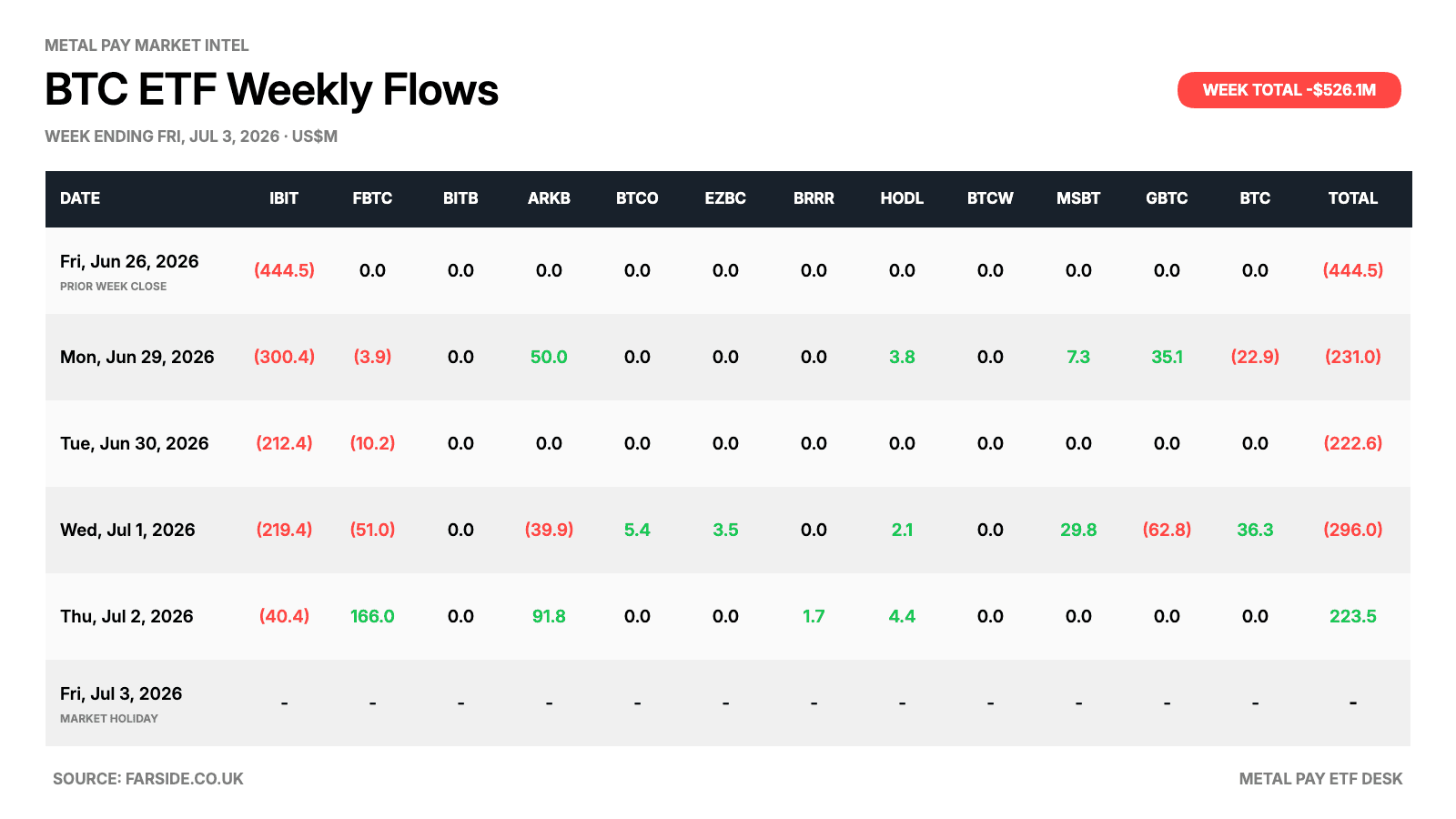
Bitcoin ETFs started the week with $231.0 million in net outflows on Monday, led by a $300.4 million withdrawal from IBIT, while ARKB, GBTC, MSBT, and HODL recorded inflows. Tuesday extended the pressure with another $222.6 million in net outflows, driven by $212.4 million leaving IBIT and $10.2 million leaving FBTC. The weakest midweek session came Wednesday, when funds lost $296.0 million as IBIT, GBTC, FBTC, and ARKB all saw redemptions, before Thursday delivered the strongest day with $223.5 million in net inflows led by FBTC and ARKB. Overall, Bitcoin ETFs finished the tracked week down $526.1 million, showing that institutional demand remained negative despite a late-week bounce.

Ethereum ETFs opened the week with $29.9 million in net outflows on Monday, as ETHB and ETH outweighed smaller inflows into ETHA, FETH, and ETHE. Tuesday stayed negative with $27.6 million in net outflows, entirely from ETHA. The strongest midweek session came Thursday, when funds added $29.0 million behind ETHA, FETH, and ETHV, while Wednesday also turned positive with $14.8 million in net inflows despite outflows from ETH, ETHB, and FETH. Overall, Ethereum ETFs finished the tracked week down just $13.7 million, a much milder result than Bitcoin and a sign that late-week demand helped offset early redemptions.
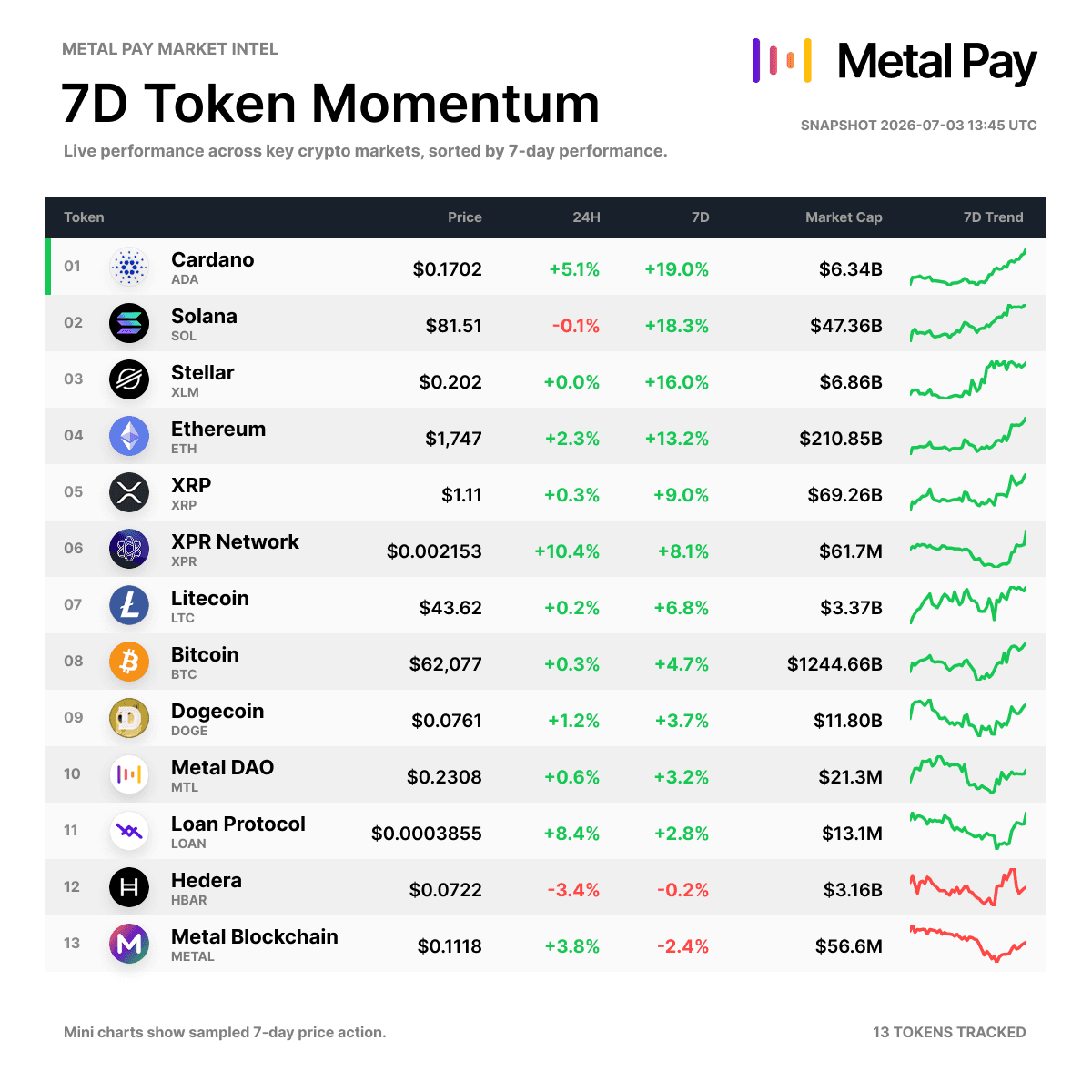
Cardano led the Metal Pay list this week with a 19.0% gain, followed closely by Solana at 18.3% and Stellar at 16.0%. The strongest performers were mostly large-cap altcoins, helped by the broader late-week relief move as rate-hike fears eased and risk assets recovered. Ethereum also gained 13.2%, while XRP, XPR Network, Litecoin, Bitcoin, Dogecoin, Metal DAO, and Loan Protocol all finished positive. Hedera and Metal Blockchain were the only tracked tokens in the red, showing that the week’s rebound was broad but not universal.