
The CFTC approved KalshiEX’s BTCPERP contract, clearing the first U.S.-regulated bitcoin perpetual futures contract for listing on a CFTC-regulated exchange. Perpetual futures are a major part of global crypto derivatives trading because they do not expire and let traders maintain leveraged exposure without rolling contracts. Until now, much of that activity has lived offshore or outside standard U.S. market structure, making this a notable step toward bringing crypto-native products under domestic oversight. Reuters also reported that Coinbase and Kalshi are moving to offer regulated perpetual crypto futures to U.S. investors, signaling a broader shift in how U.S. regulators are approaching digital-asset derivatives.
ETF Outflows Keep Market Sentiment Under Pressure
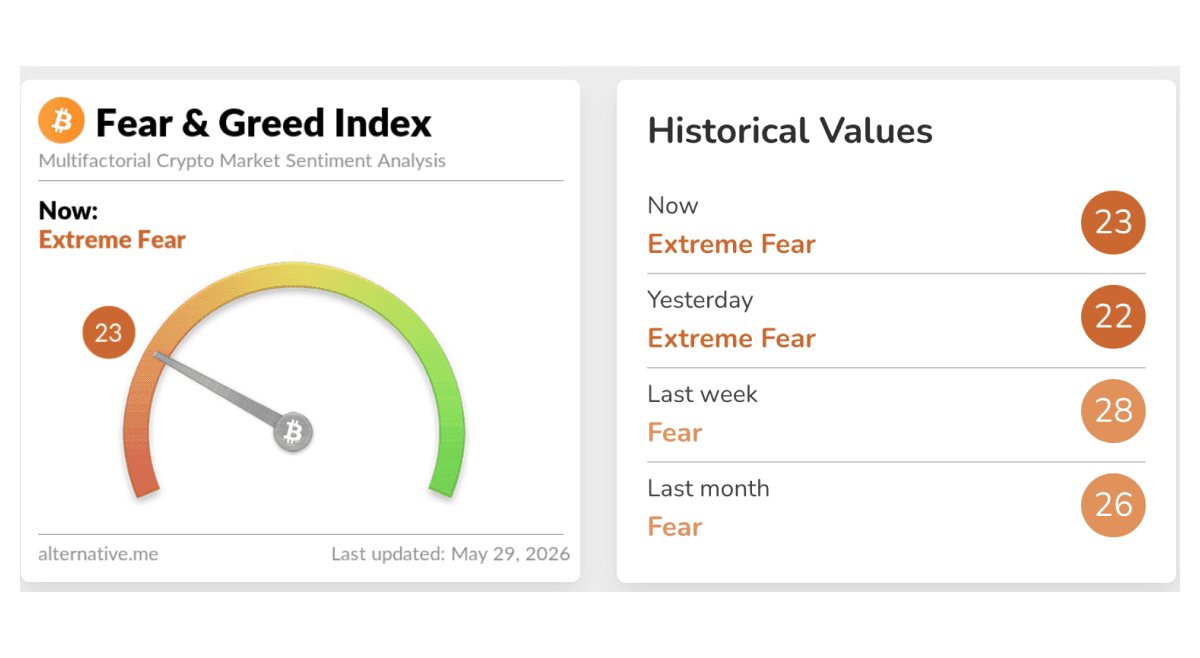
Crypto sentiment remained weak this week as Bitcoin ETF outflows extended into a record nine-day streak, with investors pulling roughly $2.8 billion across the run. The pressure showed up in the attached Fear & Greed Index, which sat at 23 on May 29, placing the market in Extreme Fear, only slightly above yesterday’s 22 reading. The broader tone reflected continued caution around Bitcoin, Ethereum and higher-beta assets, even as some tokens held up better on a relative basis. Extreme fear does not predict direction by itself, but it does show how defensive the market mood has become.
Tether Plans Government-Backed Georgian Lari Stablecoin
Tether said it plans to launch GELT, a digital token representing the Georgian lari, in partnership with the Georgian government. The company described the project as an official stablecoin initiative designed to support digital payments, fintech development and cross-border trade. Reuters noted that Tether did not clarify whether the token should be considered a central bank digital currency, which leaves some policy questions open. The announcement is still notable because it shows private stablecoin issuers continuing to work directly with governments as countries explore regulated digital money systems.
Bitcoin ETF Flows
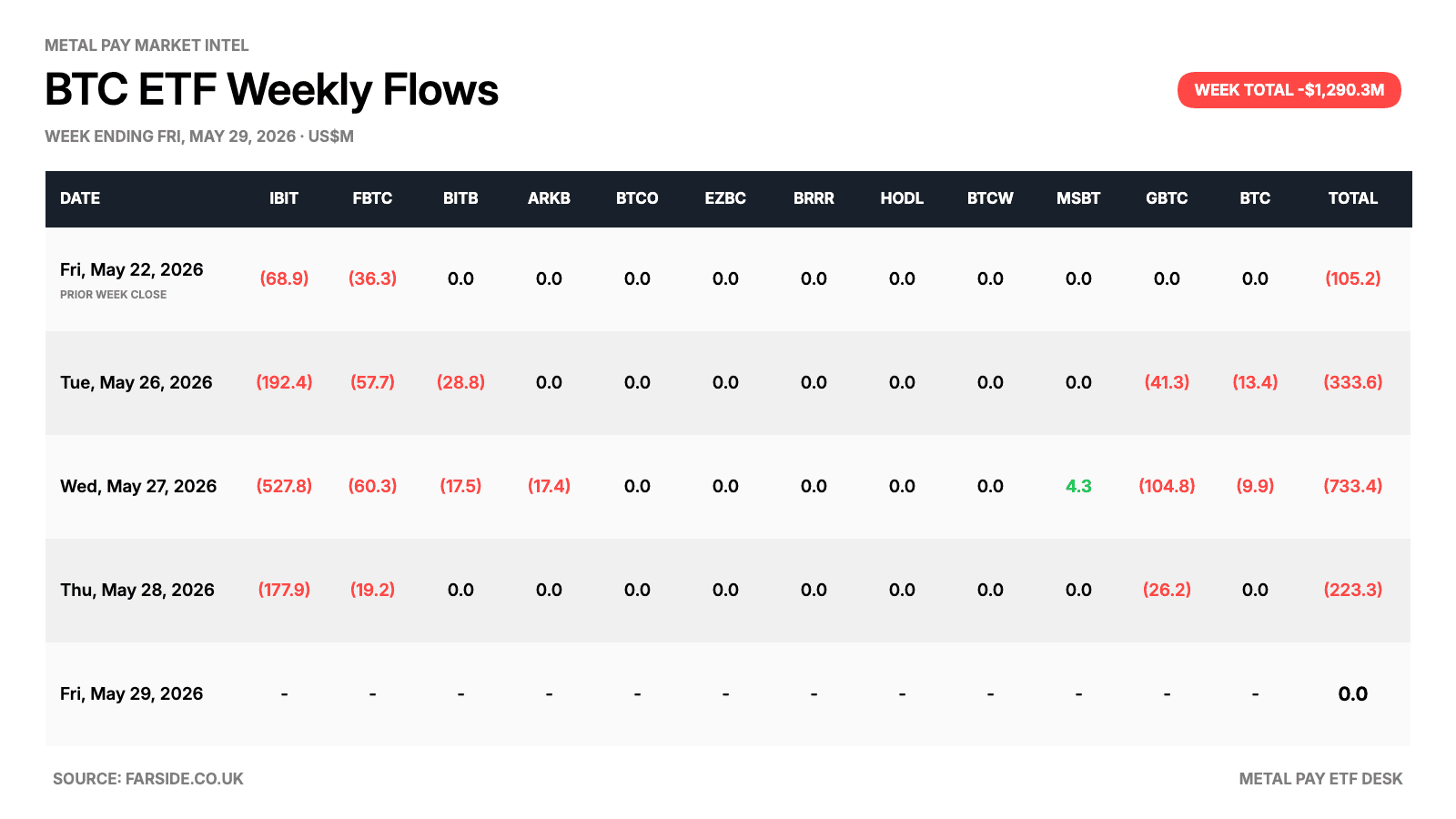
The prior Friday close showed $105.2M in net outflows for Bitcoin ETFs, led by $68.9M from IBIT and $36.3M from FBTC. Tuesday deepened the reversal with $333.6M in net outflows, led by IBIT, FBTC, BITB, GBTC and BTC. The weakest midweek day was Wednesday, when total outflows reached $733.4M, including $527.8M from IBIT, $104.8M from GBTC and $60.3M from FBTC, while MSBT was the lone green print at $4.3M. Thursday remained negative at $223.3M, driven by IBIT, GBTC and FBTC, bringing the visible week total to $1,290.3M in net outflows.
Ethereum ETF Flows
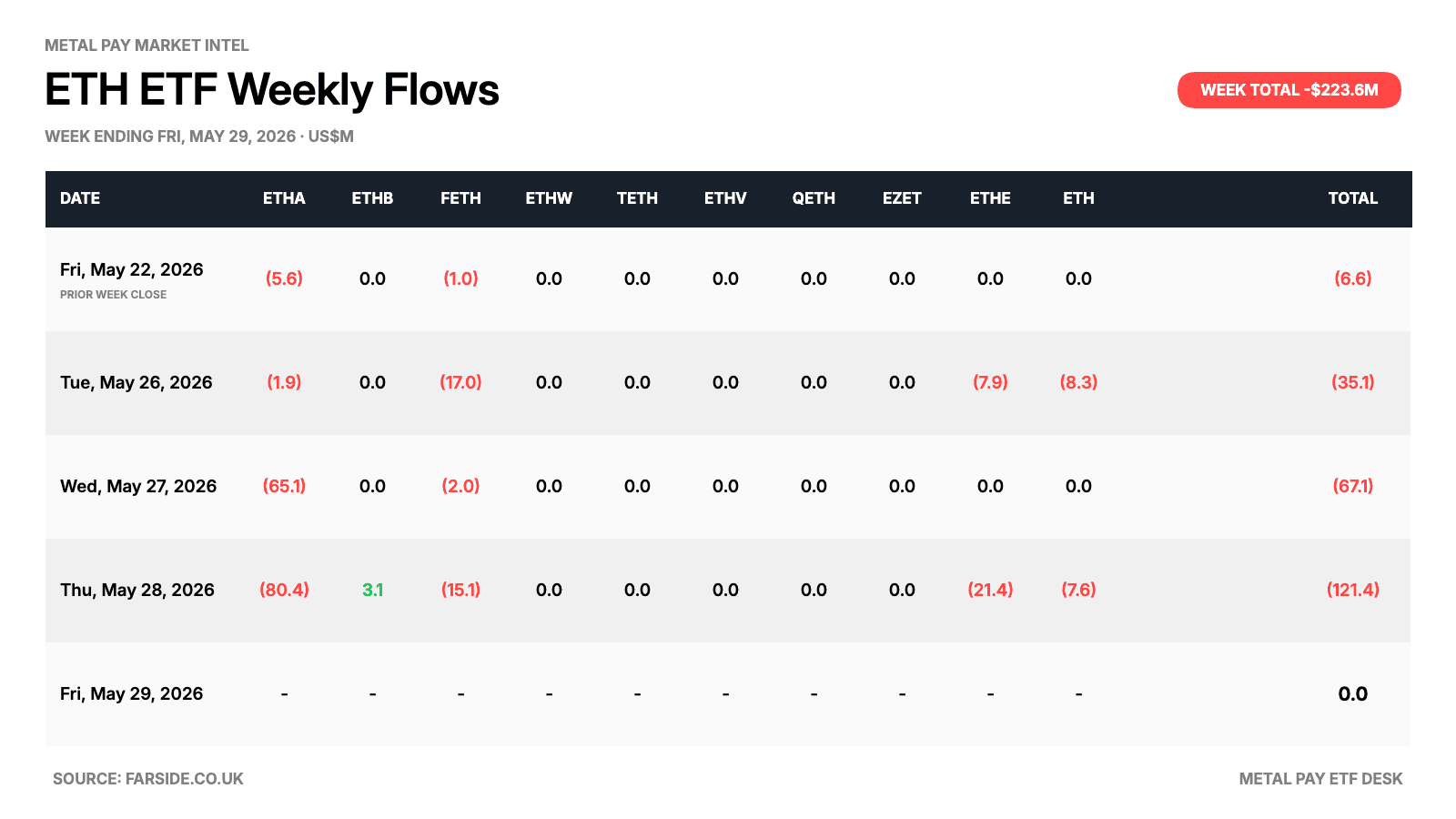
The prior Friday close showed $6.6M in net outflows for Ethereum ETFs, led by $5.6M from ETHA and $1.0M from FETH. Tuesday saw outflows widen to $35.1M, with FETH, ETH, ETHE and ETHA all negative. The weakest midweek day was Thursday, when total outflows hit $121.4M, led by $80.4M from ETHA, $21.4M from ETHE, $15.1M from FETH and $7.6M from ETH, partly offset by $3.1M into ETHB. Overall, ETH ETFs posted $223.6M in net outflows across the visible week, showing continued pressure but smaller absolute redemptions than BTC products.
Top Gainers (Coins Available on Metal Pay)
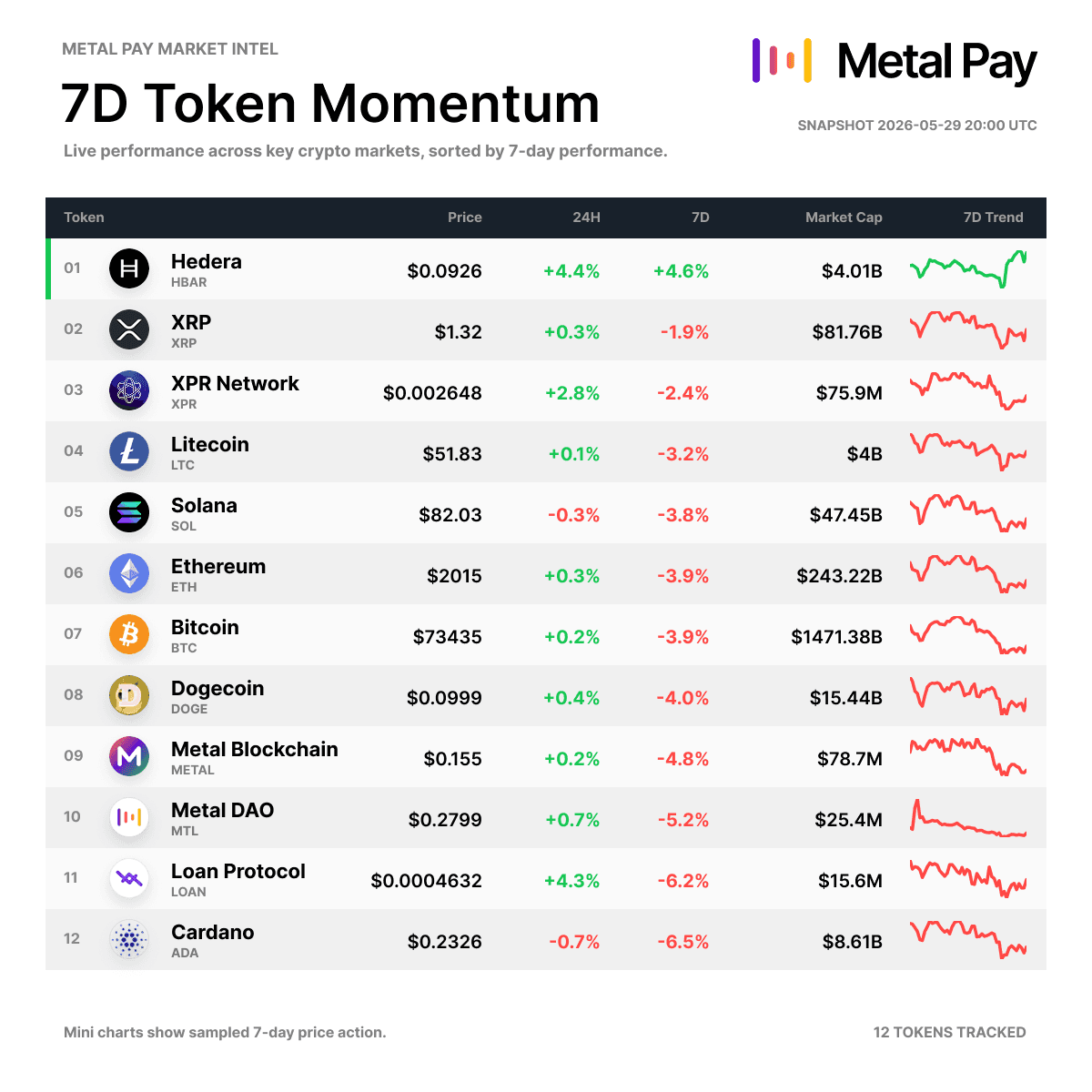
Hedera was the clear relative leader on the Metal Pay 7-day chart, rising 4.6% while most tracked assets finished lower. XRP and XPR Network held up better than the rest of the red group, down 1.9% and 2.4% respectively, while Litecoin, Solana, Ethereum and Bitcoin all slipped between 3.2% and 3.9%. With the Fear & Greed Index sitting in Extreme Fear at 23, this week’s table is less about broad upside and more about which assets resisted the downturn best. Cardano, LOAN Protocol and Metal DAO saw the largest dips among the tracked list, which some buyers may view as a signal to watch for potential entries if market sentiment stabilizes.