Metallicus announced it has achieved Request for Payment (RFP) certification for the FedNow Service, expanding its real-time payments infrastructure for U.S. credit unions and banks. With RFP now live alongside Send, Receive, and Liquidity Management capabilities, financial institutions can initiate real-time payment requests directly over the FedNow rail. That means faster settlement, improved cash flow management, and a smoother member experience for bill pay and account-to-account transfers.
For regulated institutions exploring instant payments and digital asset integrations, this milestone reinforces Metallicus’ model: modern rails, compliance-aligned infrastructure, and no requirement to move deposits or custody outside the organization.
Crypto.com Wins Conditional OCC Approval for Trust Bank
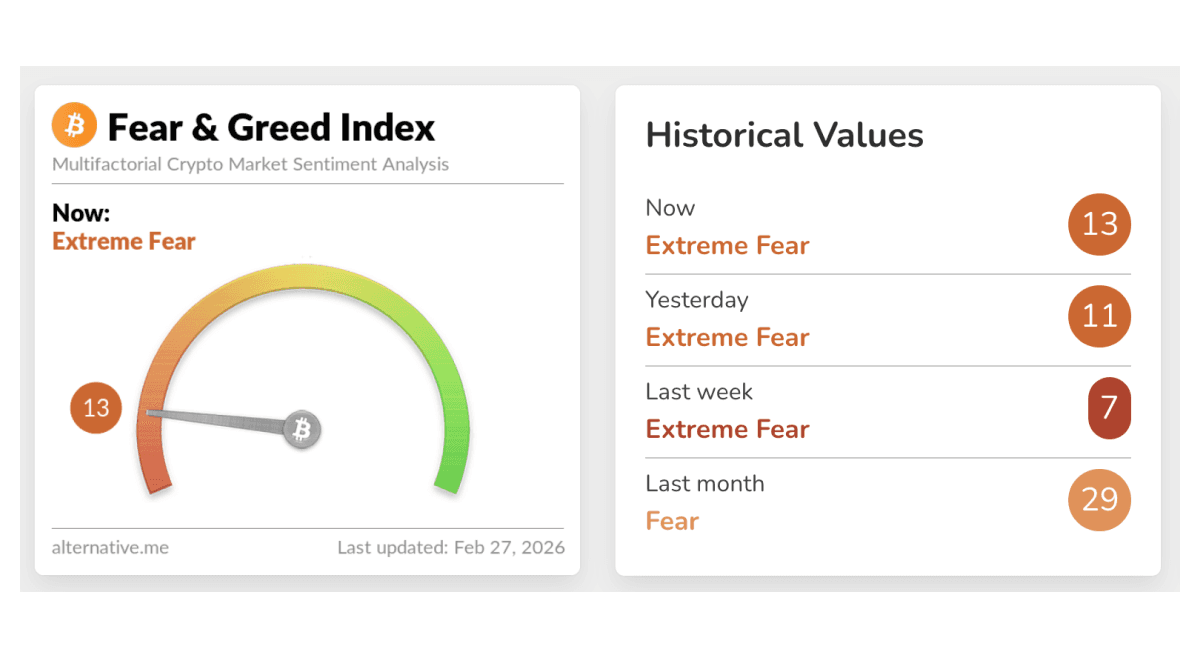
Crypto.com received conditional approval from the U.S. Office of the Comptroller of the Currency (OCC) to form a national trust bank, a meaningful step toward operating as a federally regulated digital-asset custodian. A national trust charter can broaden institutional access by formalizing custody and settlement under OCC oversight, even though it does not allow taking deposits or making loans. The move lands as market sentiment remains fragile, with the Crypto Fear & Greed Index still in “Extreme Fear” at 13 on Friday. For everyday users, this is a reminder that the plumbing, custody, compliance, and regulated rails can keep advancing even when prices and sentiment remain cautious.
SEC Updates Enforcement Process to Give More Early Notice
The U.S. Securities and Exchange Commission said it will give investigation subjects more time to respond to Wells notices and added an earlier opportunity to meet with staff within four weeks. The change is part of broader updates to internal enforcement protocols and could affect how quickly potential crypto-related cases move from inquiry to formal action. For fintech platforms and digital asset firms, the update primarily affects process and timing, offering additional opportunity to present facts before staff recommends charges. While enforcement remains active, clearer procedural guardrails may reduce uncertainty for regulated players building long-term infrastructure in the U.S.
Bitcoin ETF Flows
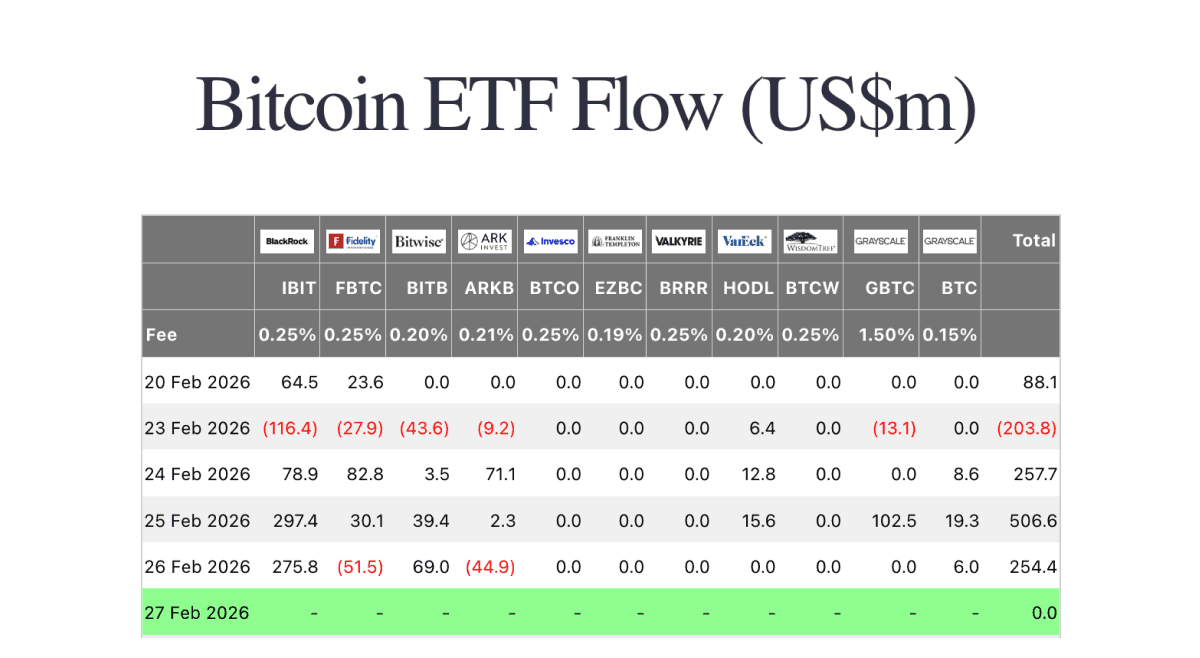
Monday saw a sharp swing to net outflows of $203.8m, led by heavy redemptions in BlackRock’s IBIT (-$116.4m) alongside losses in Bitwise’s BITB (-$43.6m) and Fidelity’s FBTC (-$27.9m). Tuesday flipped back to net inflows of $257.7m, driven by FBTC (+$82.8m), IBIT (+$78.9m), and ARK’s ARKB (+$71.1m). The strongest midweek day was Wednesday with $506.6m of net inflows, powered by IBIT (+$297.4m) and a large print in GBTC (+$102.5m), while Thursday stayed positive at $254.4m as IBIT (+$275.8m) outweighed FBTC (-$51.5m) and ARKB (-$44.9m). Friday was flat at $0.0m. Overall, spot Bitcoin ETFs finished the week with a net inflow of $814.9m.
Ethereum ETF Flows
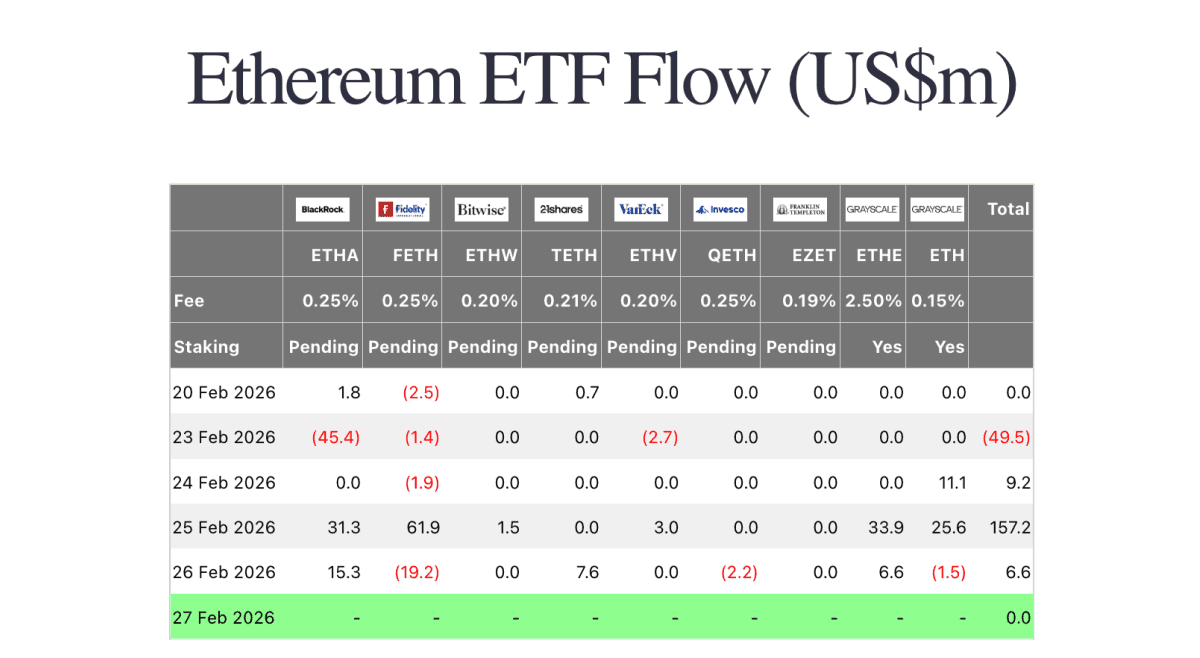
Monday started with net outflows of $49.5m, led by selling in BlackRock’s ETHA (-$45.4m) with additional pressure from Fidelity’s FETH (-$1.4m) and VanEck’s ETHV (-$2.7m). Tuesday modestly reversed to $9.2m of net inflows, helped by Grayscale’s ETH (+$11.1m) offsetting a small FETH outflow (-$1.9m). The strongest midweek day was Wednesday at $157.2m, driven by Fidelity’s FETH (+$61.9m), Grayscale’s ETHE (+$33.9m) and ETH (+$25.6m), plus ETHA (+$31.3m). Thursday remained slightly positive at $6.6m as ETHA (+$15.3m) and TETH (+$7.6m) outweighed FETH (-$19.2m) and QETH (-$2.2m). Friday was flat at $0.0m. Overall, spot Ethereum ETFs ended the week with a net inflow of $123.5m.
Top Movers (Coins Available on Metal Pay - 7 Day Chart)
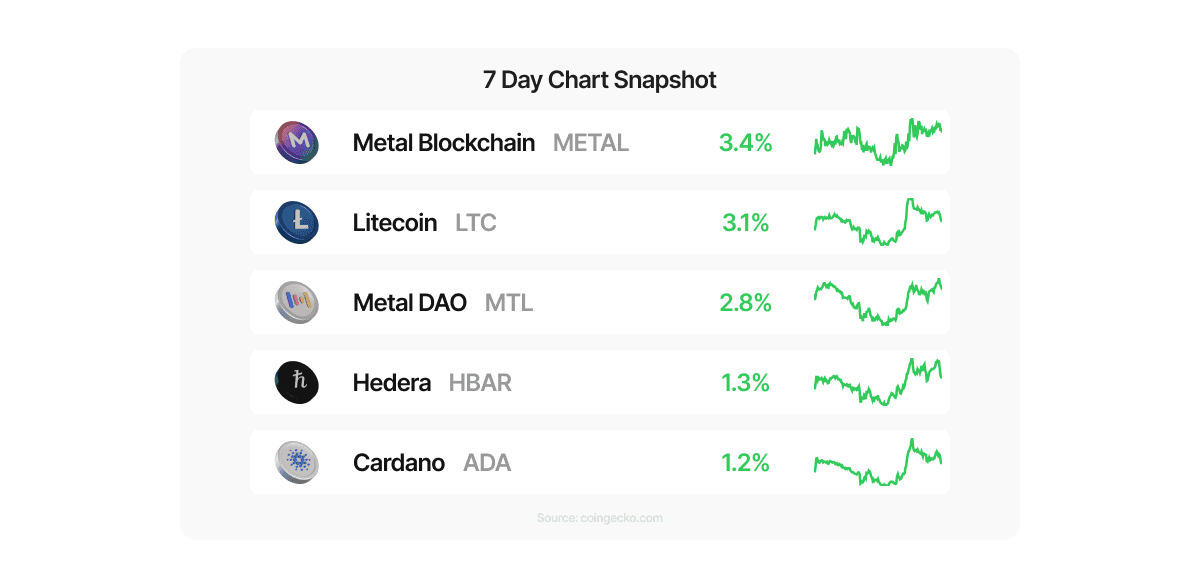
Metal Blockchain (METAL) led this week’s board with a +3.4% gain, edging out Litecoin (+3.1%) and Metal DAO (+2.8%) as the top performers in a generally cautious tape. Hedera (+1.3%) and Cardano (+1.2%) also managed to stay green, suggesting the week was more about selective stabilization than a broad risk-on rotation. With sentiment still pinned in Extreme Fear, modest positive prints like these often reflect measured dip-buying and consolidation rather than a full momentum breakout across majors.