
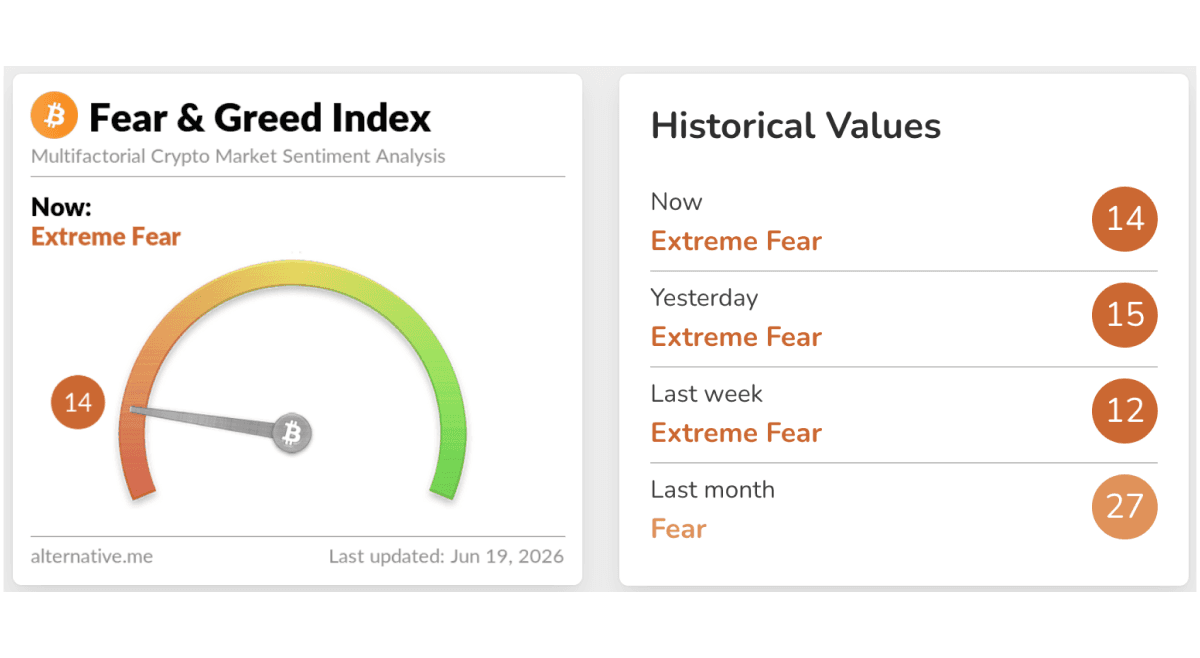
Crypto sentiment stayed deep in defensive territory on June 19, with the Alternative.me Fear & Greed Index at 14, down from 15 yesterday but slightly above last week’s 12. The reading remains firmly in Extreme Fear, while last month’s 27 still showed ordinary fear, underscoring how quickly confidence faded through June. The attached ETF tables also show pressure on regulated flows, with bitcoin products losing $227.5M and ether products losing $10.0M across the reporting window. For Metal Pay users, the takeaway is that markets are still liquid, but risk appetite remains selective and cautious.
U.S. Agencies Push Stablecoin ID Rules
U.S. regulators advanced another GENIUS Act implementation step on June 18, with FinCEN, the Fed, OCC, FDIC and NCUA proposing customer identification rules for permitted payment stablecoin issuers. The proposal would treat those issuers more like financial institutions under the Bank Secrecy Act, requiring effective programs to verify customers, keep records and screen against government lists. The proposal is open for a 60-day comment period and raises questions about whether requirements should extend into secondary-market stablecoin activity. The development matters because stablecoins are moving deeper into banking, payments and compliance infrastructure.
Strategy’s STRC Slump Tests the Bitcoin Treasury Trade
Strategy’s preferred stock STRC became one of the week’s most closely watched crypto market stress points after falling below its $100 par value, weakening a key funding channel the company has used to raise capital for bitcoin purchases. CoinDesk reported that STRC hit a record low near $89, prompting Strategy to pause new issuance through its at-the-market program because selling below par would be inefficient. The pressure follows earlier scrutiny after Strategy sold a small amount of bitcoin to help fund preferred dividends, challenging the market’s confidence in its treasury structure. For crypto investors, the story matters because Strategy has been one of bitcoin’s most visible institutional buyers, and any reduction in its buying power can weigh on sentiment during already defensive market conditions.
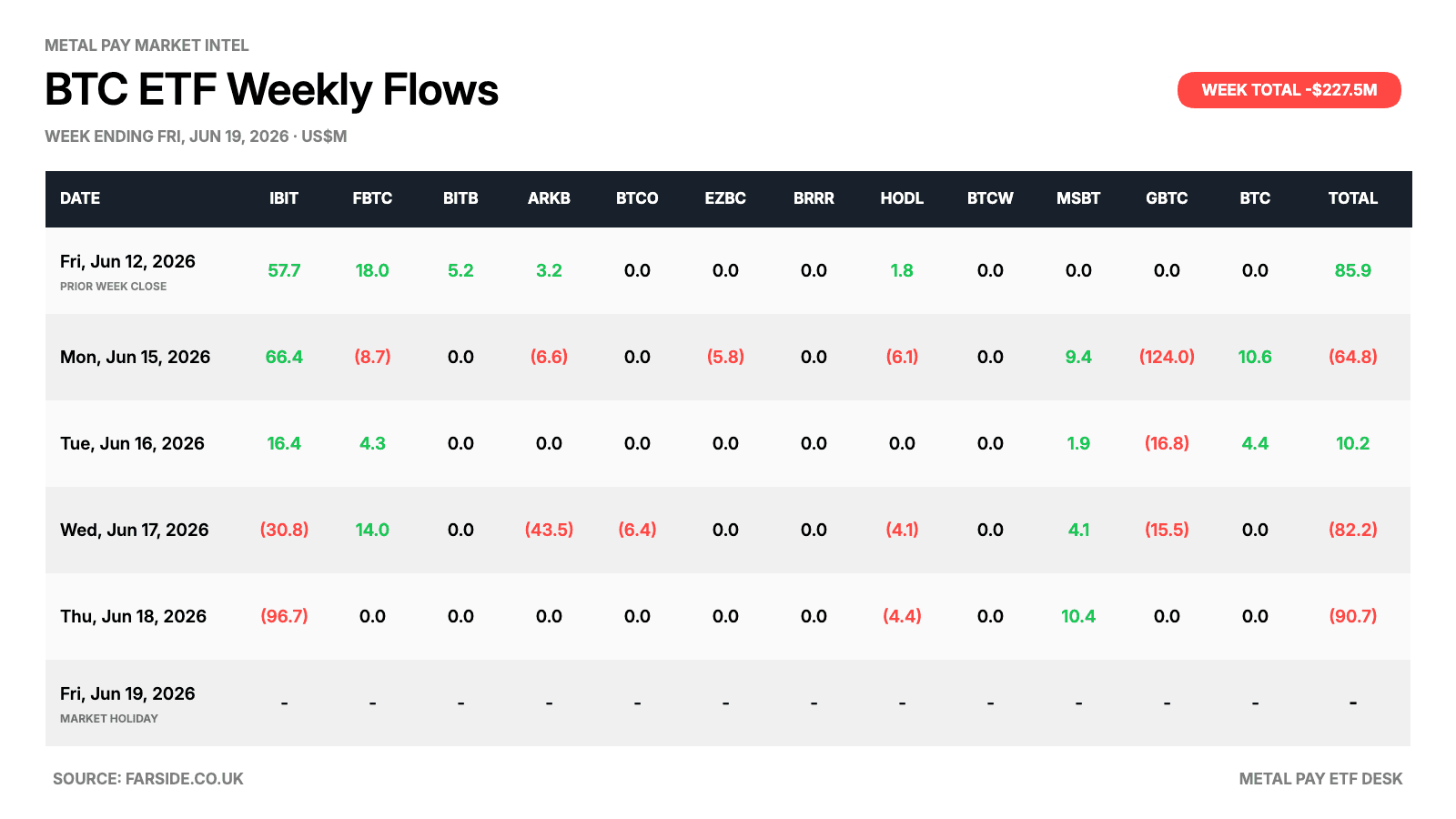
Bitcoin ETF flows opened with a $64.8M net outflow on Monday, as IBIT’s $66.4M inflow and smaller gains at MSBT and BTC were outweighed by GBTC’s $124.0M outflow. Tuesday reversed to a $10.2M inflow, with IBIT, FBTC, BTC and MSBT positive while GBTC remained the main drag. Thursday was the weakest session, with $90.7M exiting after IBIT lost $96.7M and HODL lost $4.4M, partly offset by MSBT’s $10.4M inflow; Wednesday was also negative at $82.2M. Overall, spot bitcoin ETFs ended the shortened reporting window with a $227.5M net outflow, showing institutional demand remained defensive.
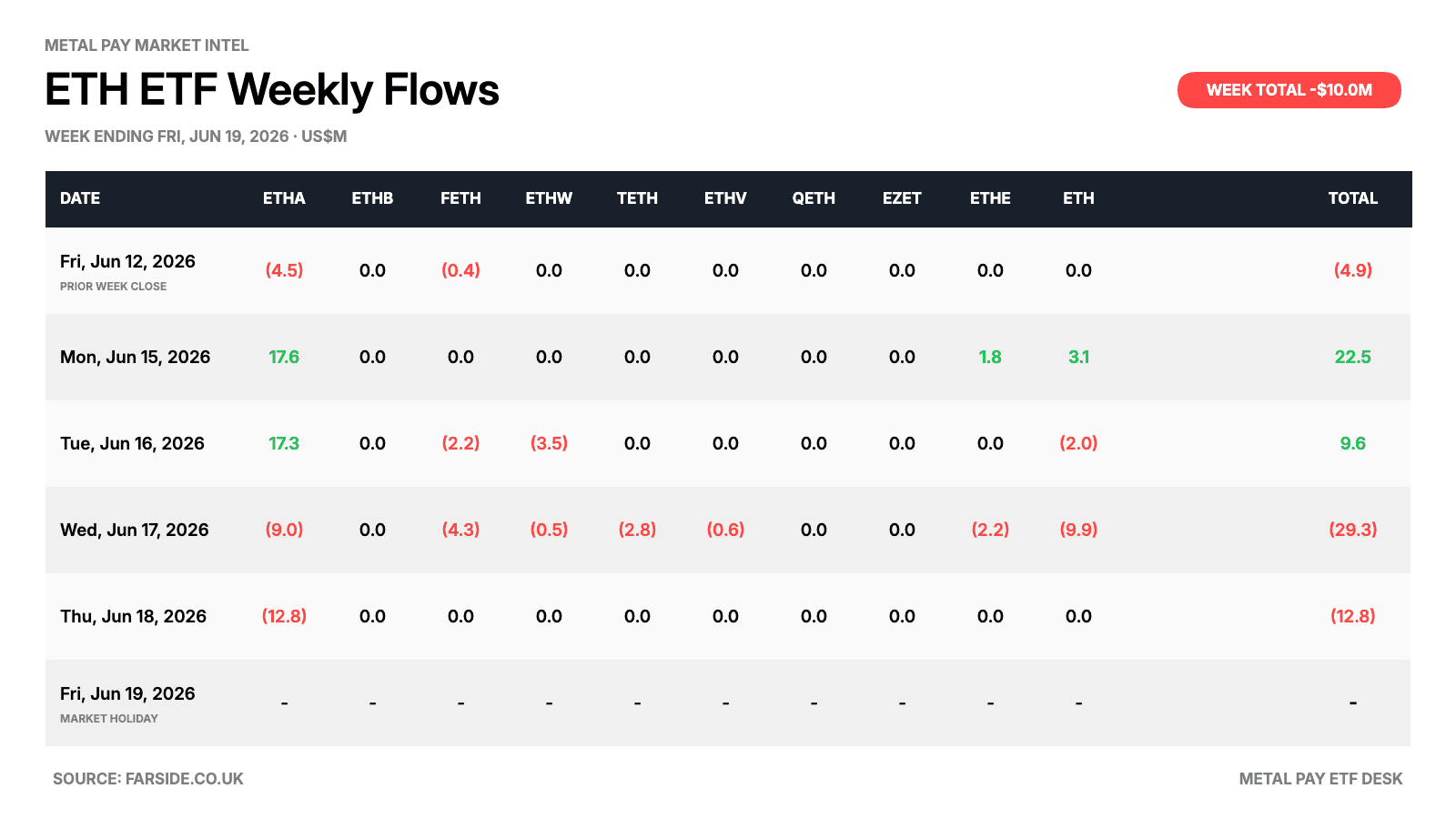
Ethereum ETF flows opened with a $22.5M net inflow on Monday, led by ETHA at $17.6M with smaller contributions from ETHE and ETH. Tuesday stayed positive at $9.6M, as ETHA added $17.3M but FETH, ETHW and ETH saw outflows. Wednesday was the weakest session, with $29.3M exiting across ETHA, FETH, ETHW, TETH, ETHV, ETHE and ETH; Thursday added another $12.8M outflow entirely from ETHA. Overall, spot ether ETFs finished with a modest $10.0M weekly outflow, as early ETHA demand was not enough to offset the midweek reversal.
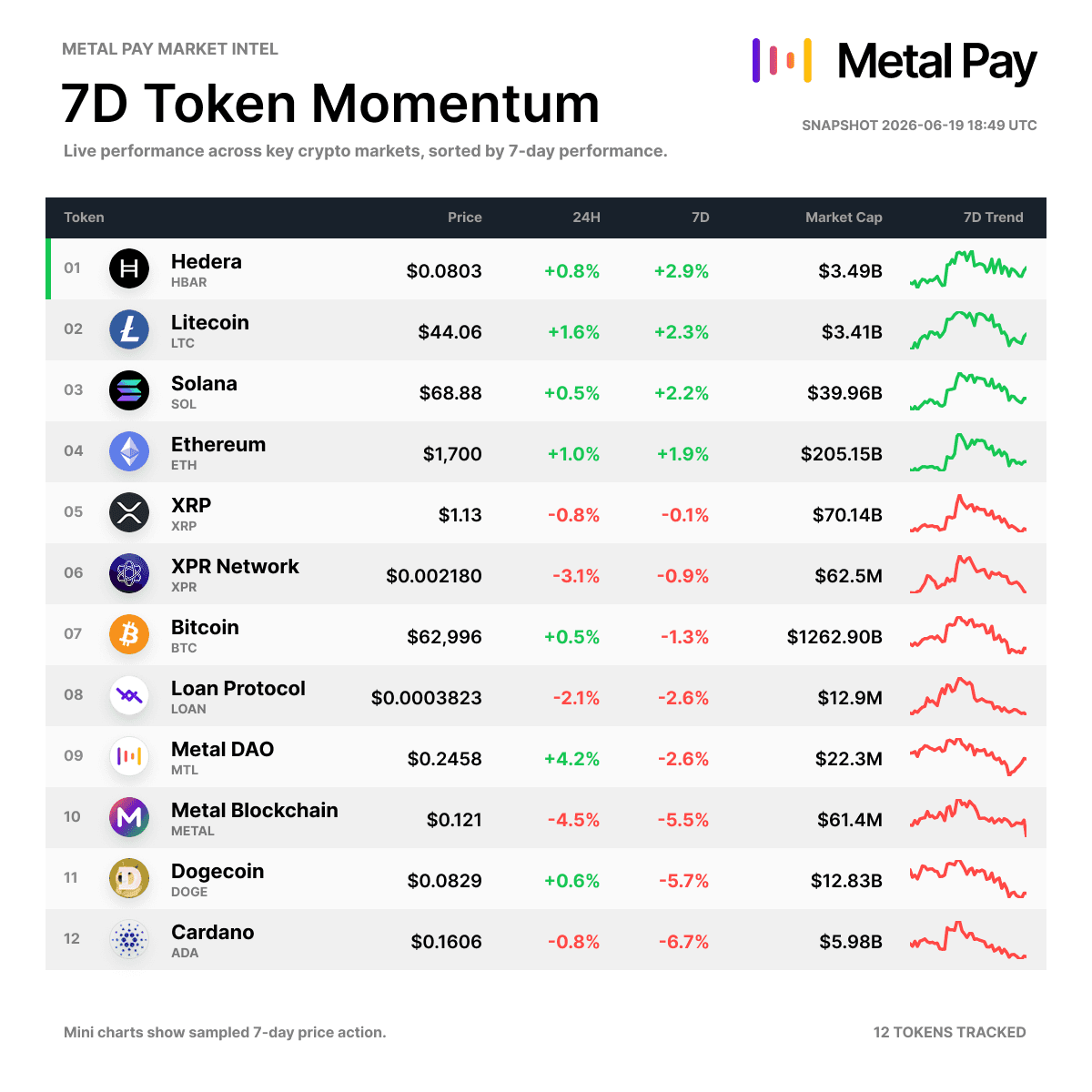
Hedera led the Metal Pay watchlist this week with a 2.9% gain, followed by Litecoin at 2.3%, Solana at 2.2% and Ethereum at 1.9%. The group shows a defensive but not fully risk-off market: a few large-cap networks managed to hold green while XRP, XPR Network and Bitcoin were only modestly lower. Weakness was more visible further down the list, with Metal Blockchain, Dogecoin and Cardano seeing the largest 7-day declines as broader crypto sentiment stayed in Extreme Fear.