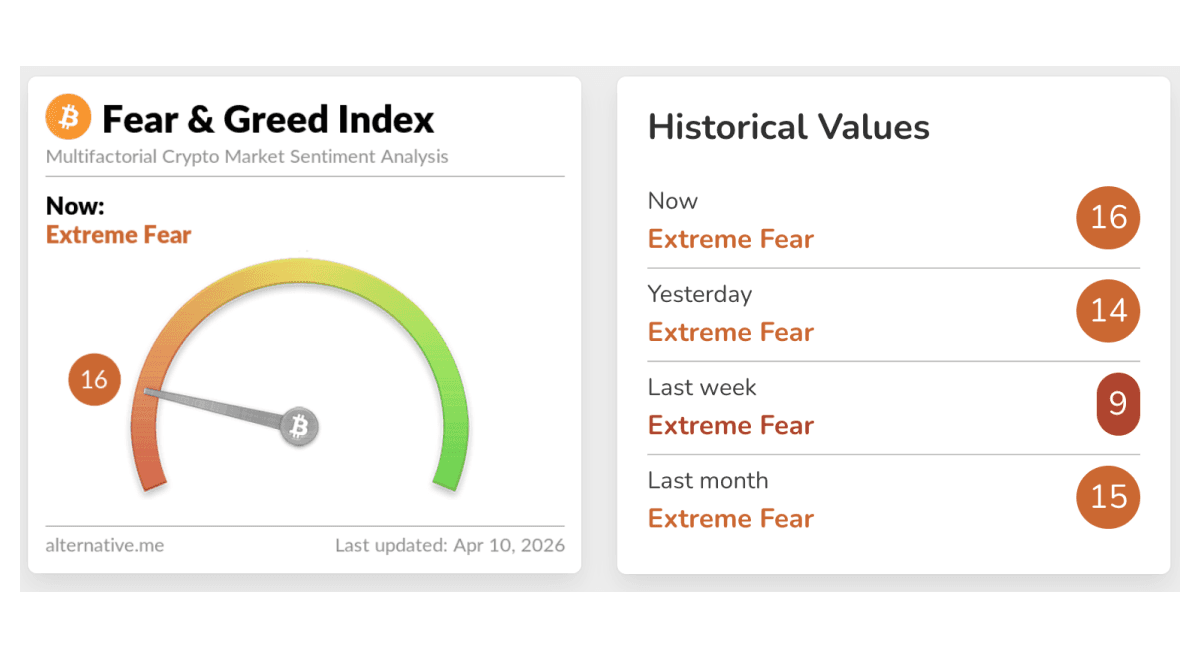
Crypto markets recovered this week as broader risk appetite improved on hopes that U.S.-Iran tensions might ease, helping bitcoin and ether move higher alongside other risk assets. Even so, the tone stayed cautious as the ceasefire narrative remained shaky and energy-market uncertainty continued to hang over macro sentiment. That caution showed up clearly in the Fear & Greed Index, which stood at 16 on April 10, up from 14 the day before and 9 a week earlier, but still firmly in Extreme Fear. For Metal Pay users, the takeaway is that price action improved, but conviction still looks thin and the market has not fully moved out of defensive mode.
Hong Kong Grants First Stablecoin Licences
Hong Kong issued its first licences for fiat-backed stablecoins this week, giving approval to HSBC and a Standard Chartered-led joint venture under the city’s new regime. The move is notable because it puts large, regulated financial institutions at the front of stablecoin issuance rather than crypto-native firms alone. Regulators said the new products are expected to launch in the second half of the year for uses including payments, merchant transactions, and tokenized investments. For the Metal Pay audience, this is another sign that stablecoins are moving deeper into mainstream financial infrastructure, especially where banks can control distribution and compliance from day one.
Swiss Banks Expand Stablecoin Testing
Six Swiss banks including UBS, PostFinance, Sygnum, Raiffeisen, ZKB, and BCV said they are joining a live sandbox to test a Swiss franc-pegged stablecoin with Swiss Stablecoin AG. The initiative is designed to connect blockchain applications to the Swiss franc in a regulated setting, addressing the fact that Switzerland still lacks a broadly used regulated franc stablecoin. The project also reflects a wider trend of banks treating stablecoins less as a fringe product and more as a strategic payments and settlement tool. For regulated fintech and banking players, it reinforces the idea that the next phase of adoption is likely to come from supervised environments rather than open-ended experimentation.
Bitcoin ETF Flows
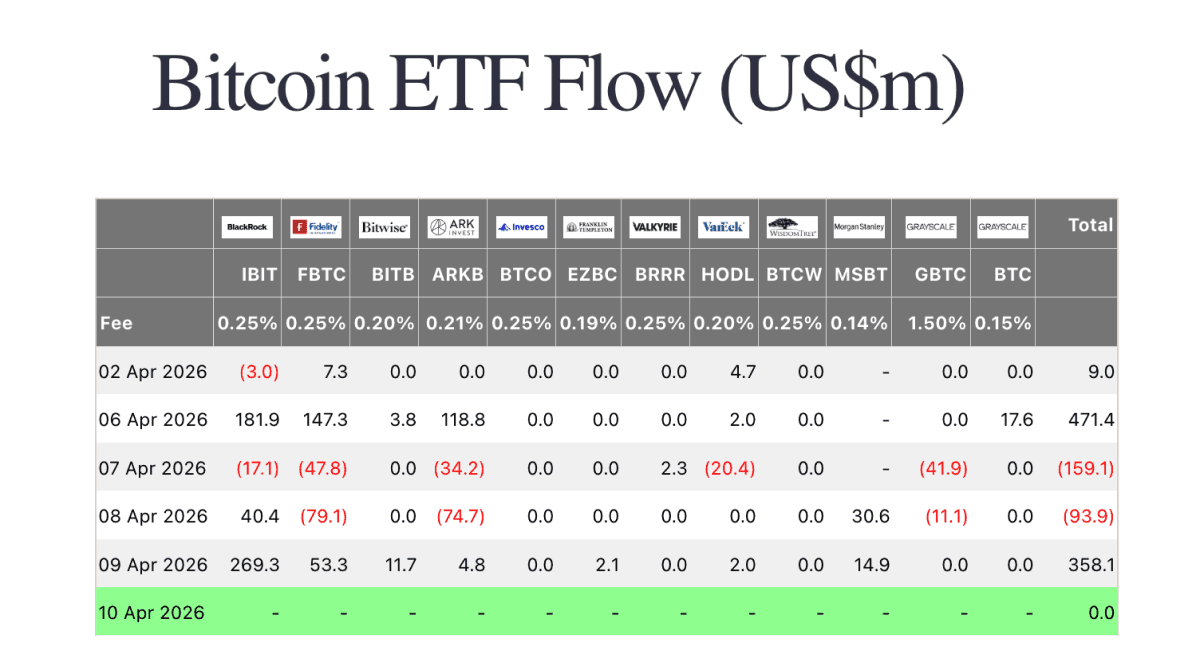
Monday brought a strong rebound in spot bitcoin ETF demand, with total net inflows of $471.4 million led by BlackRock's IBIT at $181.9 million, Fidelity's FBTC at $147.3 million, and ARKB at $118.8 million. Tuesday then flipped into outflows, with the group losing $159.1 million as FBTC, GBTC, ARKB, HODL, and IBIT all finished negative on the day. The weakest midweek session came Wednesday at negative $93.9 million, but Thursday was the strongest of the remaining sessions with $358.1 million in net inflows, again led by IBIT at $269.3 million and FBTC at $53.3 million. Overall, bitcoin ETFs stayed choppy through the week but still finished the Monday-through-Thursday stretch with solid net inflows as institutional demand returned on the stronger days.
Ethereum ETF Flows
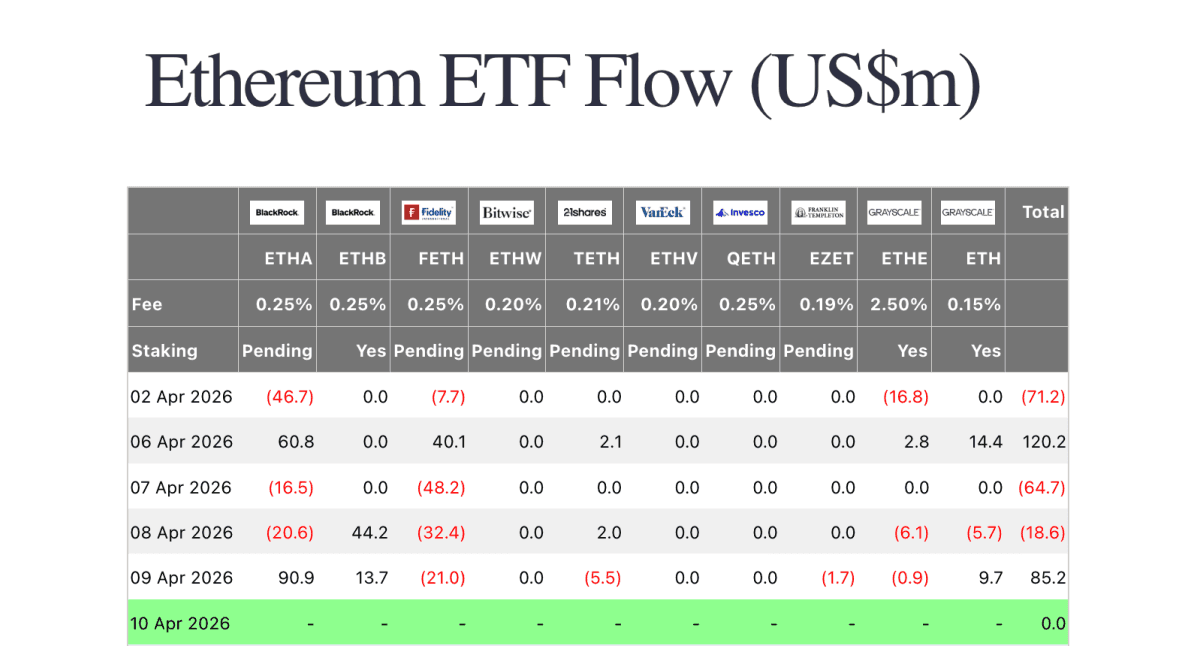
Monday started the week on firmer footing for spot ether ETFs, with $120.2 million in net inflows led by BlackRock's ETHA at $60.8 million and Fidelity's FETH at $40.1 million, with smaller contributions from Grayscale's ETH and 21Shares' TETH. Tuesday reversed sharply into $64.7 million of net outflows, driven mainly by FETH at negative $48.2 million and ETHA at negative $16.5 million. The weakest midweek day was Wednesday at negative $18.6 million, while Thursday was the strongest remaining session with $85.2 million in inflows led by ETHA at $90.9 million, partially offset by outflows from FETH, TETH, EZET, and ETHE. Overall, ether ETFs were more mixed than Monday first suggested, but the group still closed the week with a modest positive net balance across the main trading days.
Top Movers (Coins Available on Metal Pay - 7 Day Chart)
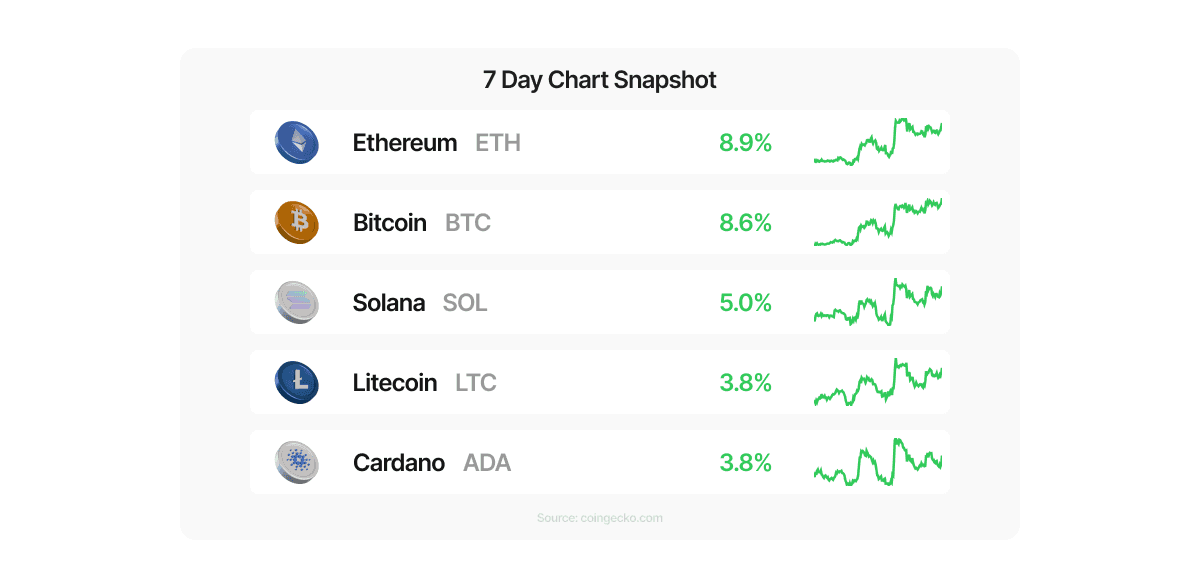
Ethereum led this week’s move on Metal Pay at +8.9%, slightly ahead of Bitcoin at +8.6%, as majors recovered with improving risk appetite and stronger ETF flow days later in the week. Solana also held up well with a 5.0% gain, while Litecoin and Cardano each added 3.8% as the rebound broadened beyond just the top two assets. In other words, this week’s winners were mostly large-cap names that benefited from a macro relief bounce rather than a narrow altcoin rotation.